
Column: How I Use Todoist
A COLUMN of David Haydl  on May 08, 2018, 17:05 am | 2 comments | Note: Column - More

This is what the author says:
I hope this article has given some people an idea on how to get started with Todoist. My tip now is that you don't just orientate yourself on my setup, it is much better if you take inspiration from several people and then develop your own system for your own purposes.
Recently mine appeared Test report on the popular task manager Todoist. Today I want to explain how I use the service for myself. To do this, I will show, among other things, the scheme I used to create my projects and the filters I use.
I use Todoist on these platforms
I use Todoist on all platforms that I use every day. On the one hand, we have my Moto G4 Plus, on which I use the Android app and the Quick Tile in the notification center, which can be activated for quick entries from Android Nougat. Then I still have my Zenbook UX530UX from Asus, on which I use the Windows app, the web app in Chrome and the extension for the browser mentioned above. I'm not that enthusiastic about the Windows app because there are often bugs, errors in synchronization and fewer features. That's why I've used the latter options on my Zenbook for the most part to access Todoist.
My homepage
For those who don't know: In Todoist, you can choose where to land when you start the service. You can do that in the settings and under the item General change. I have currently set myself up so that every time I see the list of all tasks for the next seven days. For a short time it was mine Dashboard Filter at this point, but that changed quickly. I will explain later how I use my filters. Perhaps it is also worth mentioning that I currently have the graphite Use design, which you can easily change under Settings and Topics.

When I open Todoist, I see all the tasks for the next seven days (screenshot: TechnikNews, 2018)
I create my entries according to this pattern
You've probably already seen in the screenshots of my test report that I format all my tasks in a special way. Usually, at the beginning of each entry, you'll see a specific keyword in bold followed by a colon. You get the bold font by putting two exclamation marks directly to the right and left of one or more words. This keyword is usually the name of the assigned project or the name of an attached label. For school-related things, I usually use the name of the relevant subject here. After this keyword comes the actual task, then the project, labels, a date and possibly a priority level are added.

I format my entries according to this pattern (screenshot: TechnikNews)
Inbox
The inbox is like a neutral project in Todoist. You can easily record tasks in it without much effort and give them a "home" later. I found that this feature is particularly useful during lessons at school. It allows me to quickly save things using my phone or laptop so that I can assign a project, due date and labels after the lesson.
Ways to organize your tasks in Todoist
In Todoist, there are three main ways to sort your tasks: projects, labels, and filters. In the following part, I want to go into more detail about how I use these three options for myself.
Projects

A list of my projects (screenshot: TechnikNews, 2018)
I use projects the most when I want to find a specific task quickly. The four mainproProjects represent the major areas of my life: school, private tasks, things for TechnikNews and a private sideproproject. I'm partly under youproassigned to projects, such as with JHG1 (school) the subproject Get-to-know days. In almost every project I have inserted headers to show as many subproto avoid projects. Headers are created by putting a colon at the end of a new task.
My project JHG1 for school things is divided into subject-specific headers. At the top of the list you will find three further subdivisions for general things in my school life. At the end of all projects there is another subdivision called WITHOUT ASSIGNMENT. All new tasks are automatically added there so that I can then assign them to the appropriate section.
After that comes my folder for things related to TechnikNews. I have divided this again with headings. As subproI have projects Article ideas and Review. The first subproI believe that jekt is self-explanatory, the second will contain news from the world of technology for a week, which I could write about if I find the time. Hofer Doors Homepage is a private sideproject of mine where tasks (or tasks) related to it go in.
Next comes my project for all private things. I have also divided this into headers so that I can sort the tasks better within. There are three subfolders for this folder.proprojects The first is my reading list, which always has three or four books I might read next. You can also find the book I'm currently working on there. After that Routines, where I write down all of my routines for a week, like planning the next week every Saturday. In irgendwann Mainly things come in that I could do when I have a little free time, but are not particularly important.

Headers are used to divide my projects (screenshot: TechnikNews, 2018)
I have added emojis that I find appropriate to all project names.
labels
I use labels to categorize my tasks more precisely. At the top of the list you will find my labels, which indicate how much time I want to devote to a certain task. They all got the light green color. Then there are three labels in dark green color that do all of the tasks for TechnikNews determine more precisely. This is followed by labels that I use to mark all the things that need to be done at school. Then there are four general labels with the color purple. The last two labels always show me what exactly I need to do a certain task. Here, too, each label has a matching emoji.
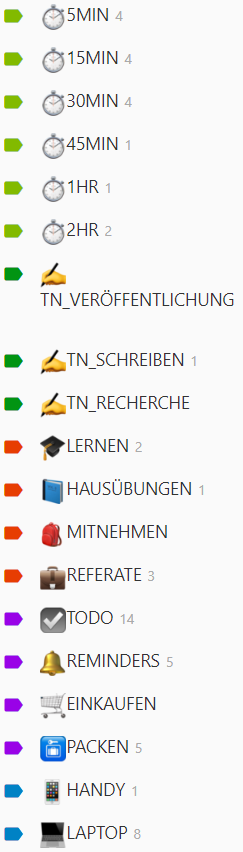
I use these labels (screenshot: TechnikNews, 2018)
Filter
Filters are by far the ones I use the least. This may be because I don't have that many tasks yet, so I can't find them in my projects straight away. The top three filters are general filters, below Dashboard, Important and grocery list. Dashboard gives me an overview of the most important tasks that are due today. Important shows me all tasks that are due today and that have received a priority flag and are in grocery list I see all the things that I still have to buy today. Then there are four filters for school-specific tasks. In the first two I see which homework I still have to do today and tomorrow, the other two show me which subjects I still have to learn today or tomorrow.

A detailed overview with all my filters (assembly: TechnikNews, 2018)
The next two filters are both related to TechnikNews. They show me which things I still have to do today or tomorrow. Finally, I have five standard filters from Todoist in which I can find tasks with no due date or a specific priority flag.
Priority flags
Many people use the priority flags according to a certain scheme, for me it is currently more a matter of feeling than a system. If I know that a task is particularly important, it gets priority 1, the highest priority in the Todoist world. General tasks do not receive a flag, which means that they are automatically recognized as priority 4. Priority two and three are currently assigned to me based on feeling, maybe that will change over time.
Integrations
In terms of integrations, I currently use the one for the Google Calendar and the one for our team messenger Slack.
The integration for the Google Calendar enables a two-way synchronization. This means that all tasks that I add in Todoist can be seen immediately in my calendar and all appointments that I add with the calendar T can be seen immediately in my Todoist list. This enables me to plan my week easily, as I can easily organize tasks and appointments in one place so that I have enough time for everything. Of course, a native calendar function in Todoist would be more practical here.
The integration for Slack allows me to quickly add tasks to my inbox. However, I hardly needed that yet.
Great insight. I also use Todoist on a daily basis. Would appreciate a continuation of this article as you use it today.
Hello Laurenz,
I am glad that you like the article. I'll see if there will be a sequel.
LG
David from TechnikNews