
Renault Rafale E-Tech 300 4×4 (2026) review: A French car that delivers premium quality
A TEST REPORT from Kasimir Hupe  on June 09, 2026, 9:51 pm | Write a comment
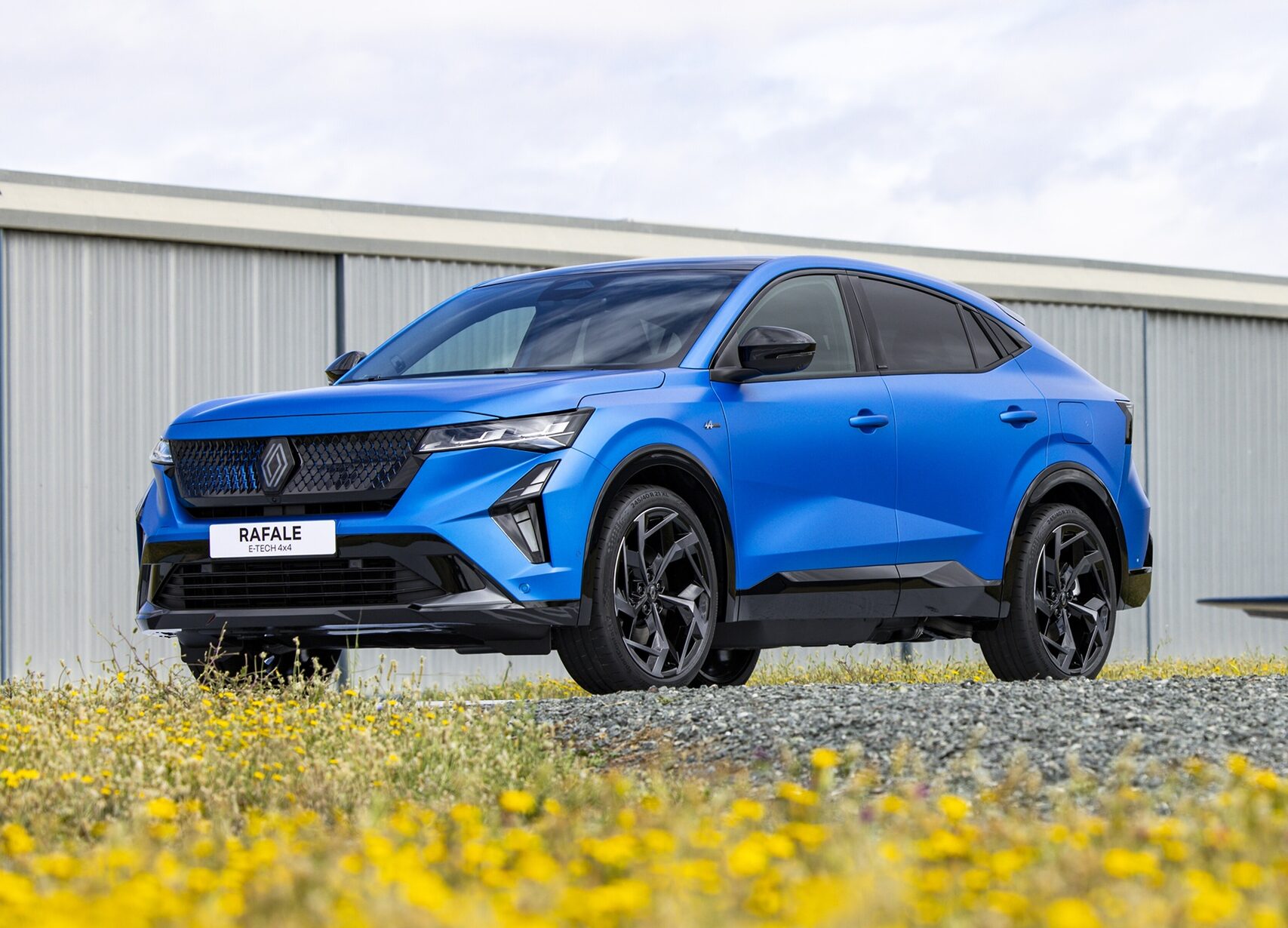
Four engines, 300 hp, a chassis from Alpine, and a price that should make the German establishment nervous. We have the Renault Rafale, the new top model and currently driving Renault's only plug-in hybrid for two weeks: on country roads and highways as well as through the morning commuter traffic.
The name says it all, and it's old. Rafale was a name used in the 1930s. Racing and record-breaking aircraft from Caudron-Renault, which, powered by engines from Billancourt, shattered speed and distance records left and right. That Renault has revived this name specifically for its new SUV coupé is no coincidence, but a clear statement. Since CEO Luca de Meo set out to lead the brand out of the valley of interchangeable compact cars, Renault has been consistently pursuing a move upwards, into a segment where BMW, Audi, and Mercedes have traditionally been the dominant players. The Rafale, launched in 2024 and built at the Palencia plant in Spain, is the spearhead of this offensive. It shares its platform with the Espace, but sports a significantly more aggressive design and ranges from the 200-hp full hybrid base model to the top-of-the-line version under discussion here.
With the E-Tech Plug-in Hybrid 300 4x4 in the Atelier Alpine trim, Renault is pulling out all the stops. For the first time, its in-house performance brand Alpine is tweaking a production SUV from the core brand, and not just with logos and blue stitching, but where it really matters: the chassis. Renault likes to draw on its history of high-performance sedans, from the R21 Turbo to the Safrane Baccara Biturbo. Whether the Rafale lives up to this legacy, however, remains to be seen, not only in France, but also on German roads, against established German rivals, and at a price starting at around €58.000. We investigated whether there's substance behind the grand gesture.
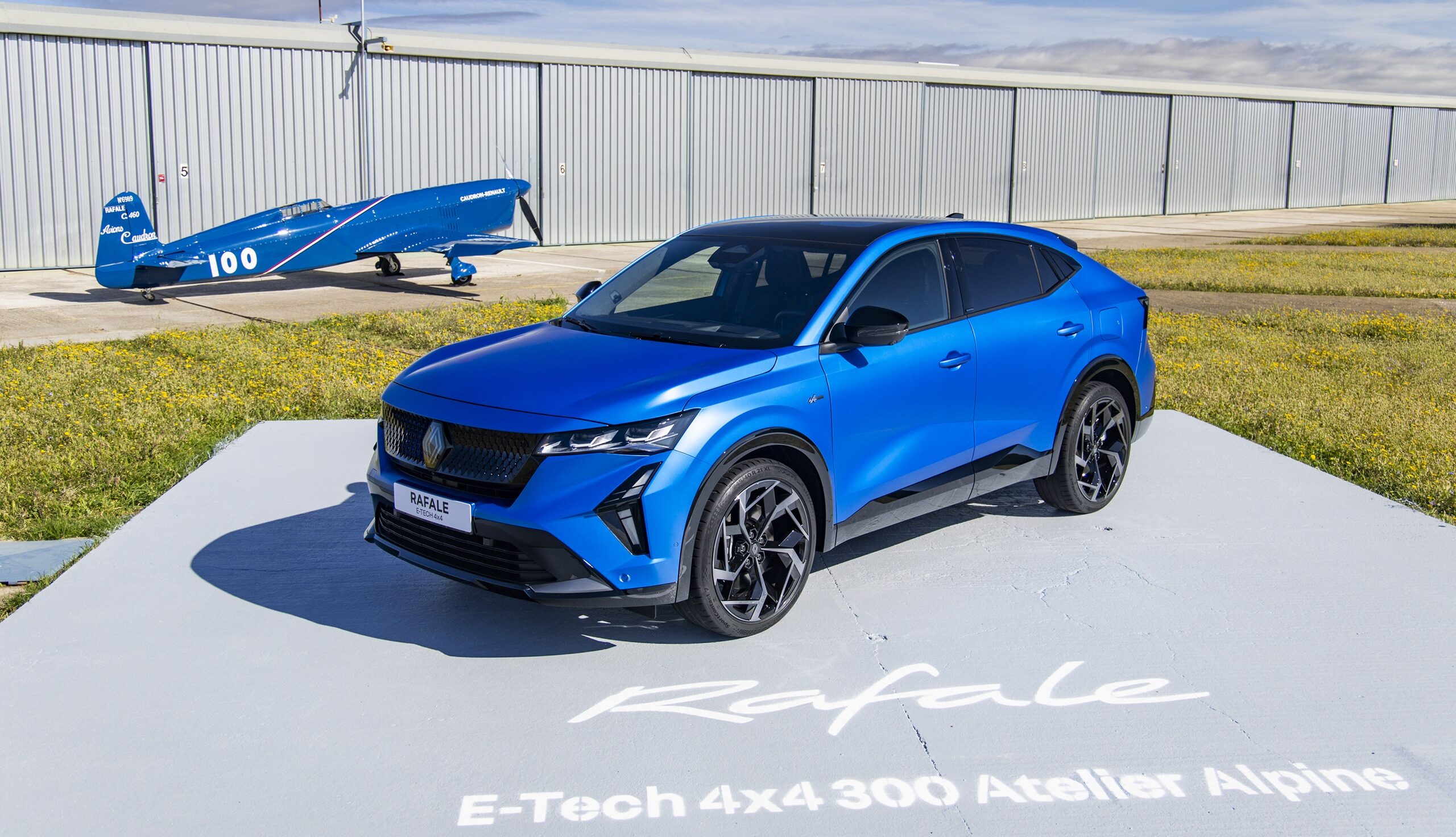
Image: Renault
The Renault Rafale E-Tech 4x4 Plug-in Hybrid 300 is the most convincing proof that Renault's move into the premium segment is not just marketing hype, but a serious and well-executed strategy. Almost everything about it is spot on: a design that inspires desire, a powertrain with genuine everyday electric usability, a chassis that manages the balancing act between sportiness and long-distance comfort better than some competitors, and an infotainment system that truly rivals the German market leaders. The weaknesses – the firm ride, the noisy three-cylinder engine when the battery is depleted, and the lack of fast charging – are there, but forgivable in the overall picture and largely attributable to its consistently sporty character.
The recommendation is therefore clear: Anyone with a parking space with charging facilities, who regularly drives short to medium distances and isn't bothered by the Renault logo, will find this a sensible and appealing option, easily saving the equivalent of a well-equipped small car compared to a similar BMW or Audi. However, those who never charge, frequently drive long distances on the motorway, or...proThose seeking uncompromising ride comfort should opt for the more affordable full hybrid 200 or the 20-inch Esprit Alpine variant. For everyone else: The Rafale E-Tech Plug-in Hybrid 300 is the smart money choice in its class.
Strengths and weaknesses of the Renault Rafale E-Tech Plug-in Hybrid 300:
✅ Strengthen:
- A distinctive, high-quality design that competes on equal footing with significantly more expensive premium competitors.
- Large 22 kWh battery with a practical electric range (around 75–85 km in real-world driving) and full boot space despite PHEV technology
- Excellent Alpine-tuned chassis with camera-based damping and standard all-wheel steering.
- Superior driving performance with a fully charged battery (0–100 km/h in 6,4 s) and permanent, intelligent all-wheel drive
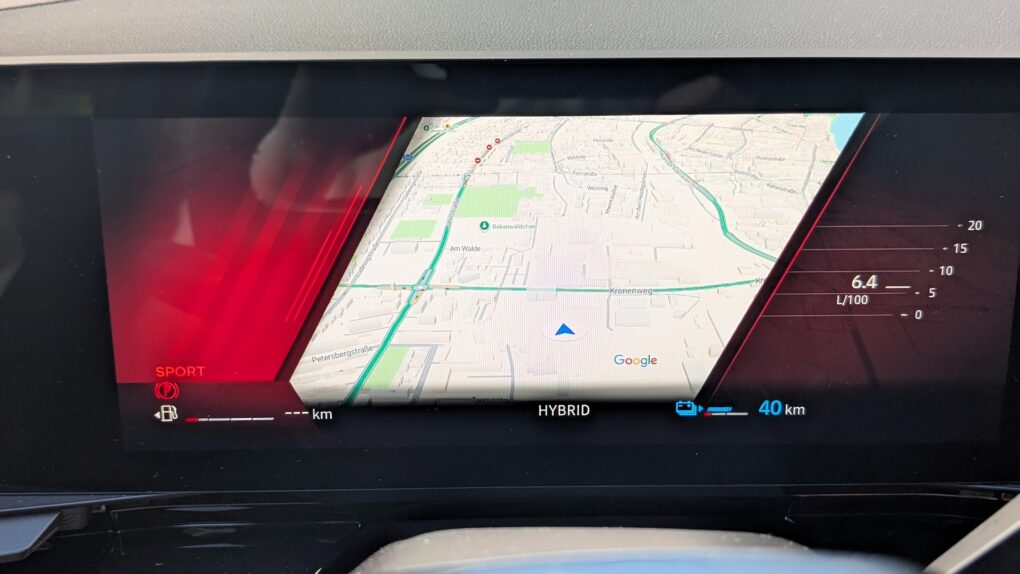
- Top-of-the-line infotainment system based on Android Automotive with native Google Maps and fast operation
- Generous standard equipment and good value for money (around €15.000 cheaper than the X4 30e or Q5 TFSI e)
- Well-thought-out detailed solutions such as the My Safety Switch and the Fireman Access battery system
❌ Weaknesses:
- No one-pedal driving
- A three-cylinder engine sounds unrefined under load when the battery is empty.
- The transmission occasionally hesitates during hard kickdown.
- Single-phase AC charging only at 7,4 kW, no DC fast charging option
- Some harder plastics are used in the interior.
Design and exterior of the Renault Rafale E-Tech Plug-in Hybrid 300: French sharpness meets show car attitude
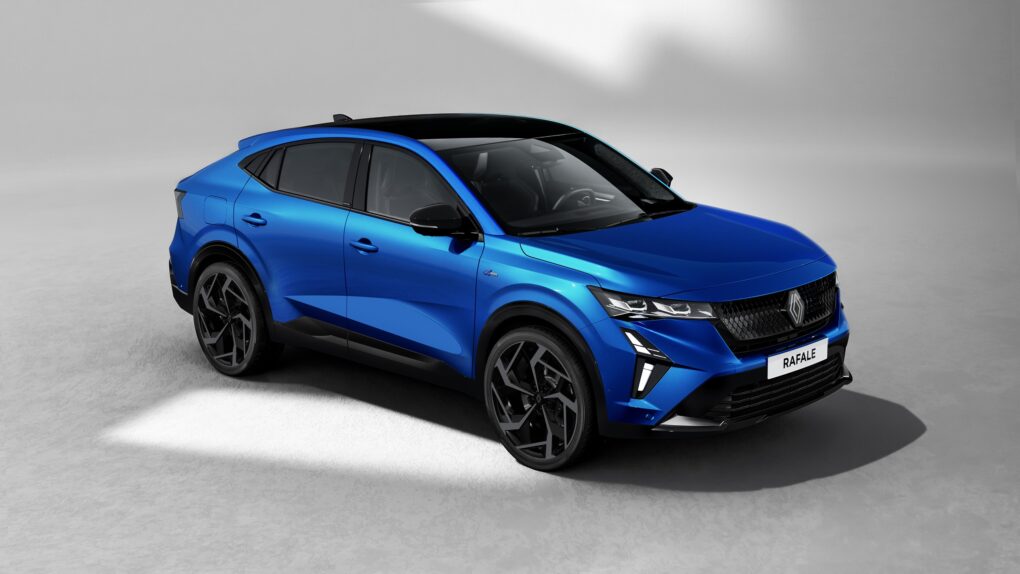
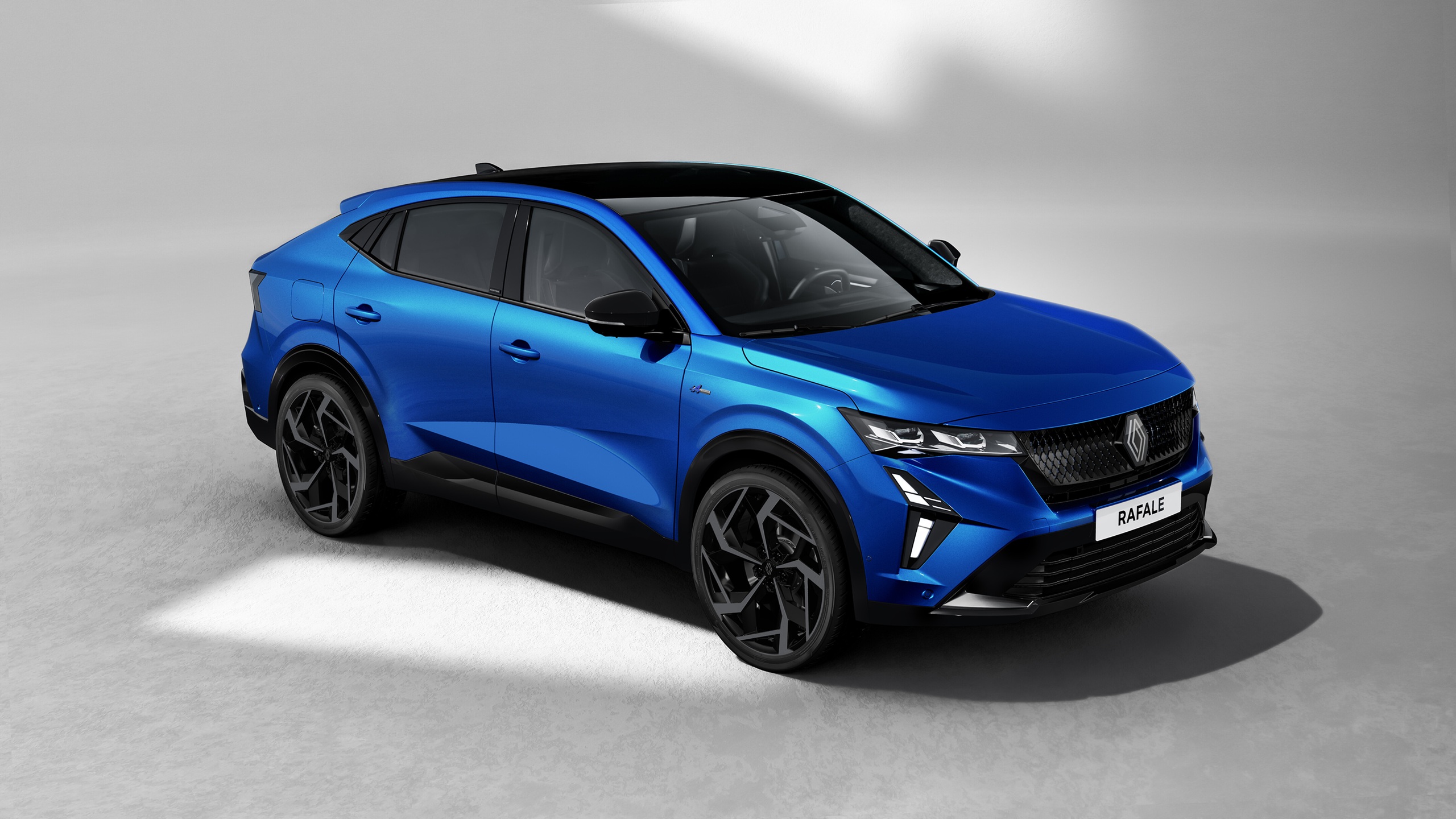
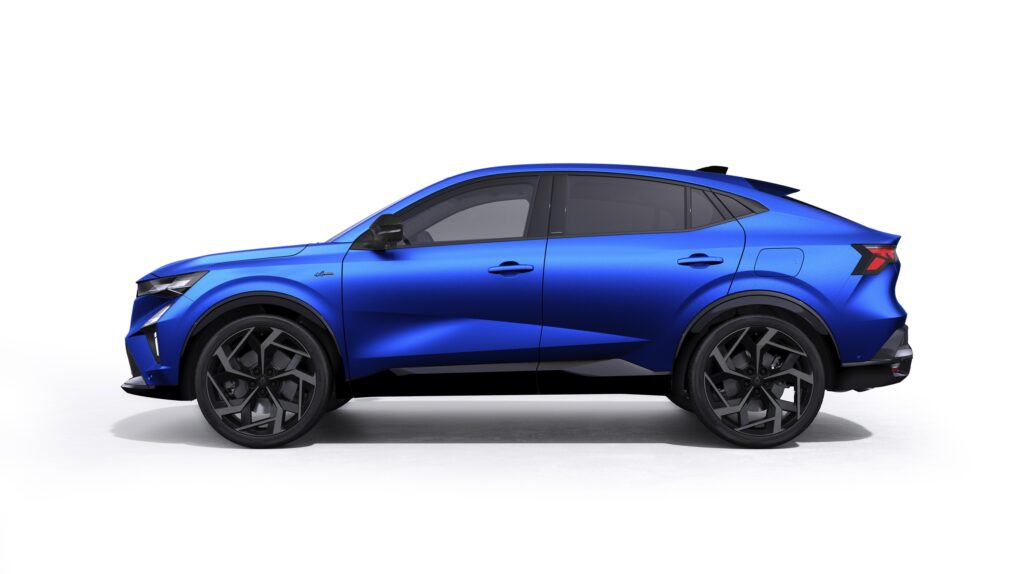
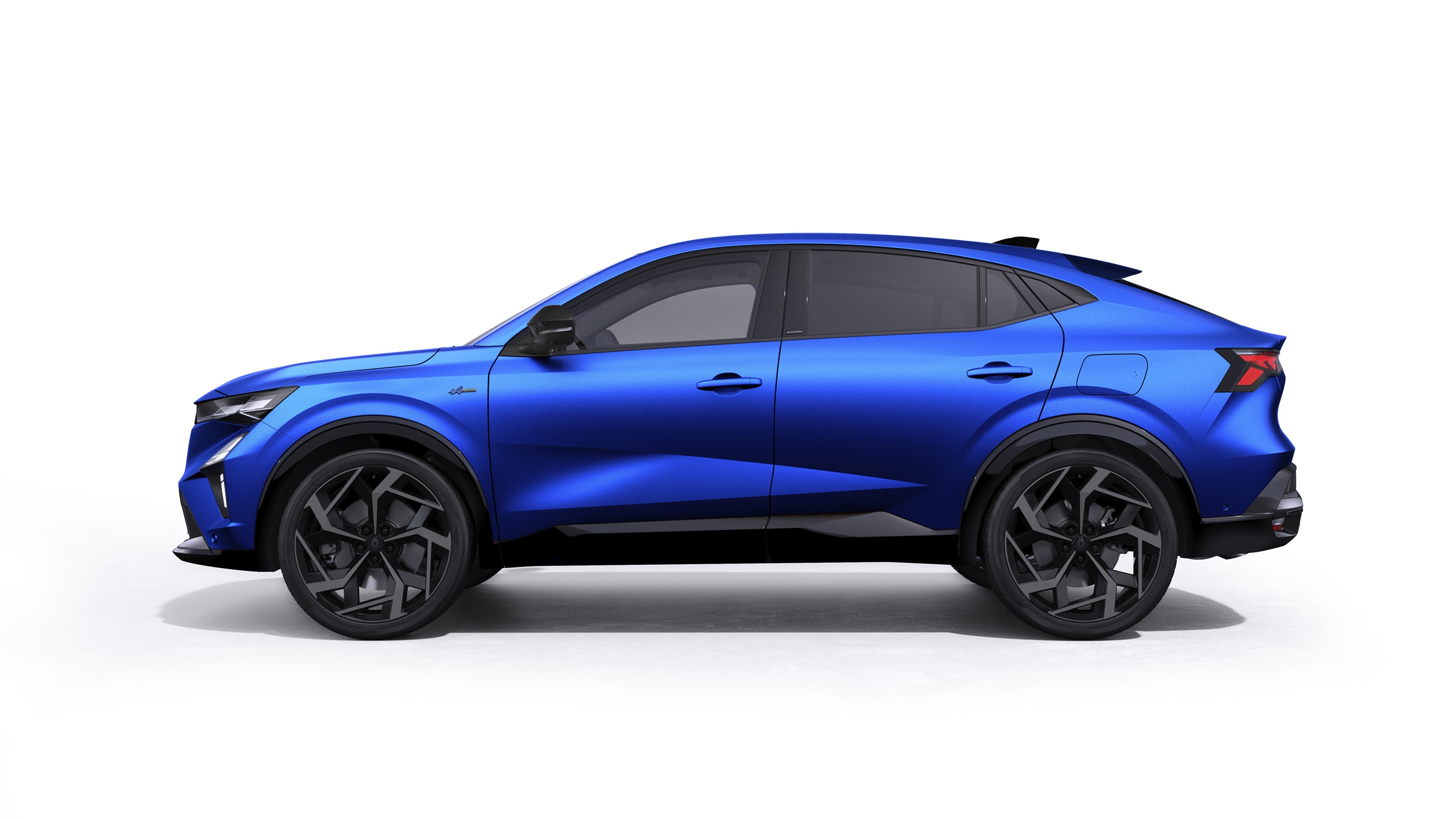
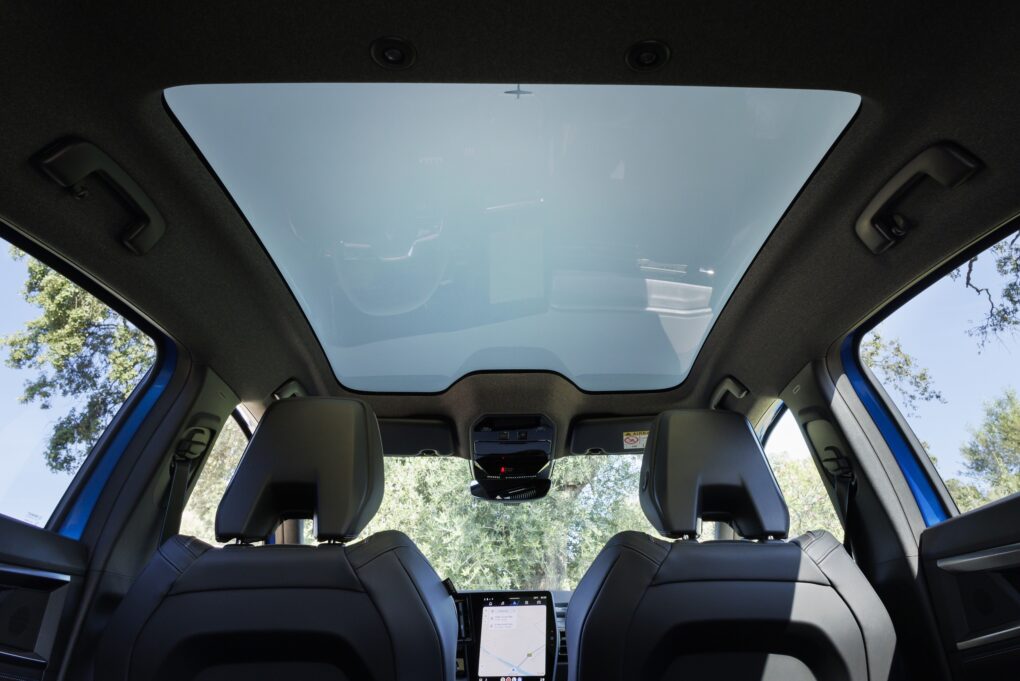
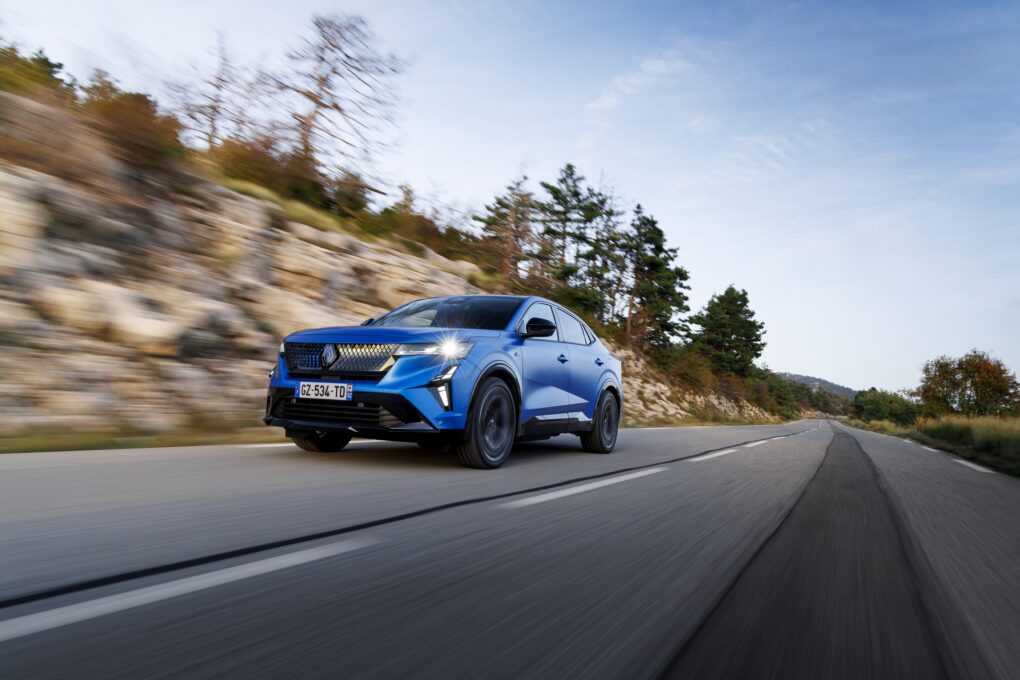
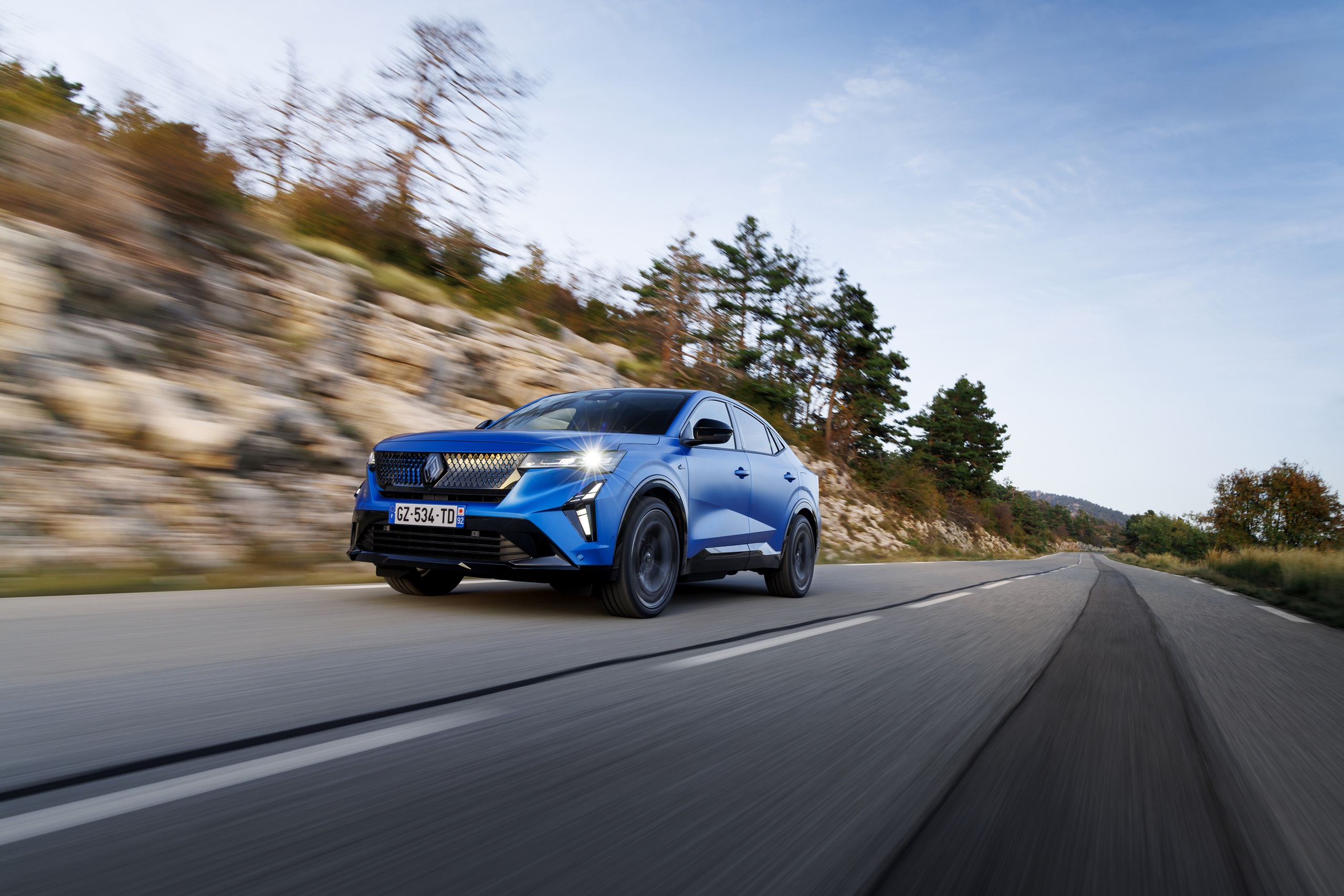
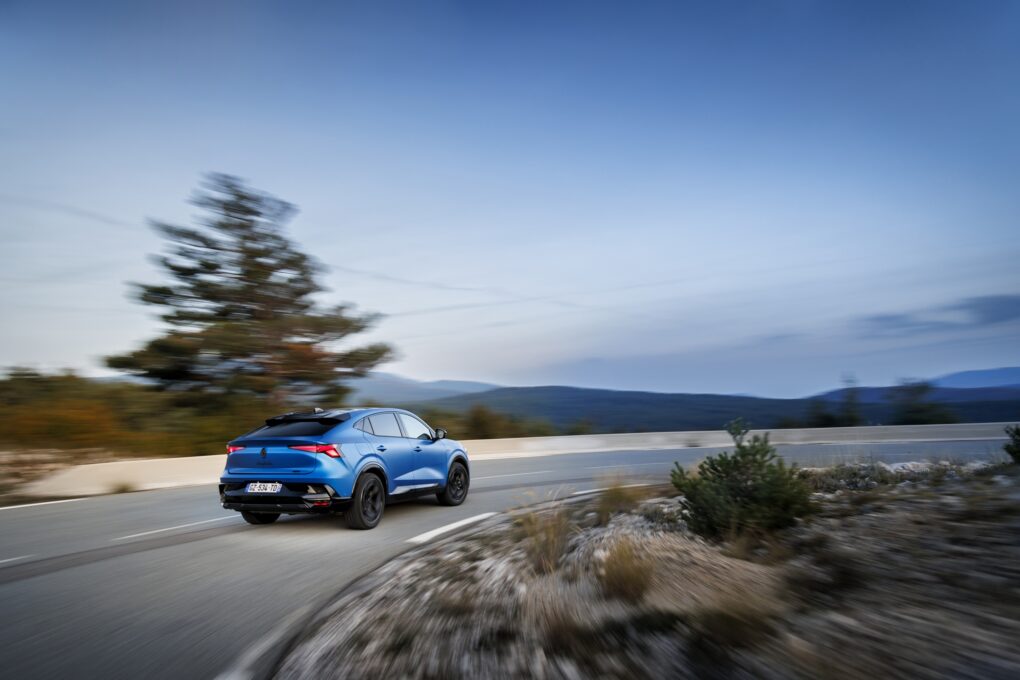
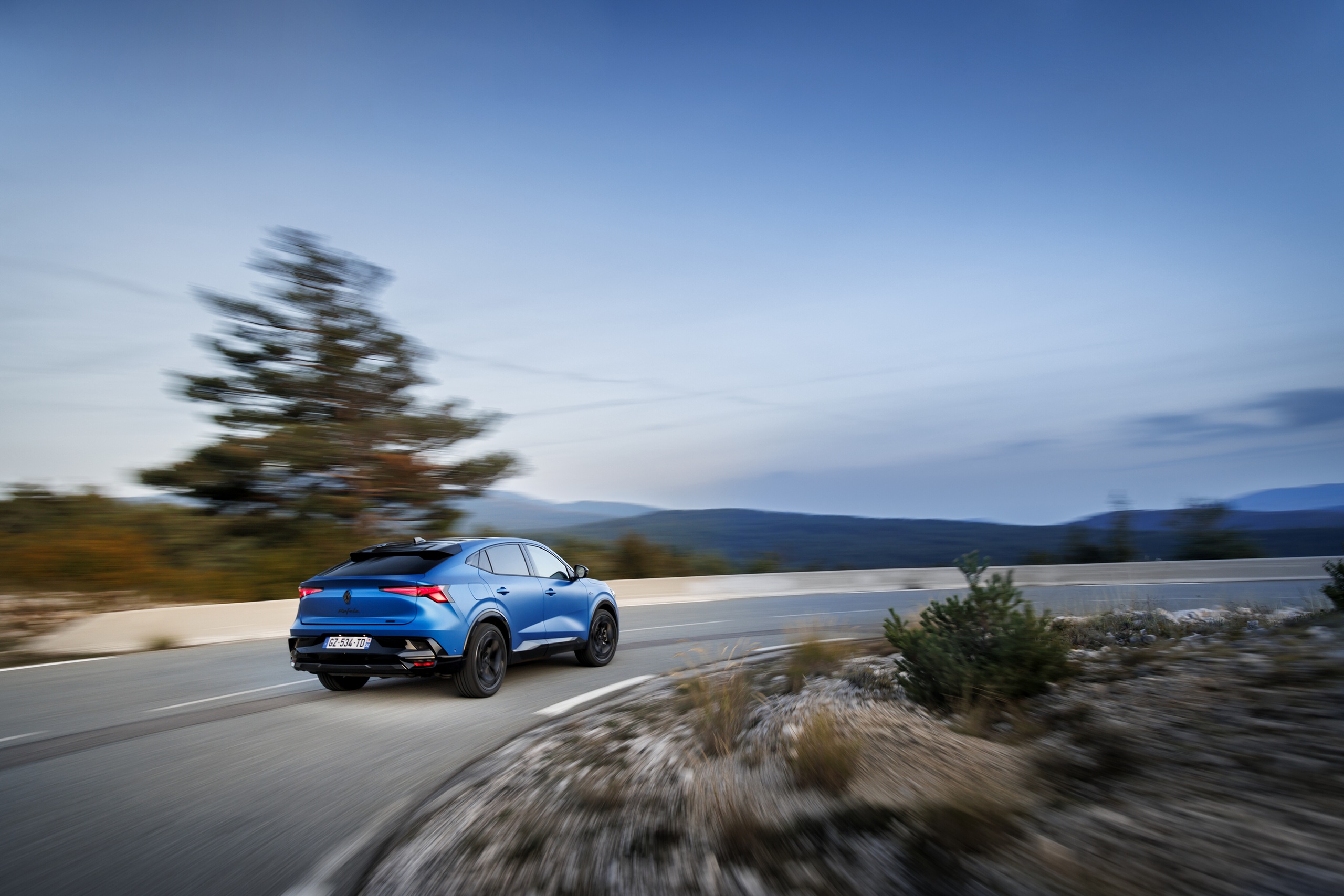
Visually, the Renault Rafale a bombshellAnd all this without sounding loud. At 4,71 meters long, 1,87 meters wide, and only 1,61 meters high, the SUV coupé sits lower to the road than its high seating position would suggest. The sharply defined front end, with its three-dimensional diamond grille that shifts between slate gray and blue depending on the light, and the optional matrix LED headlights, looks determined, almost menacing. The muscular shoulders over the rear axle and the gently sloping roofline give the car a dynamic presence that one wouldn't expect from a 4,71-meter crossover. Especially in the exclusive satin-finish Summit Blue paint, reserved for the Atelier Alpine version, the Rafale simply looks more expensive than it is.
The details reveal that a design team clearly enjoyed their work. The taillights are inspired by the Chinese tangram puzzle and, when switched off, resemble floating ice cubes; at night, the micro-optics come to life. The 21-inch Chicane-design wheels with Continental SportContact 7 tires in 245/40 fill the wheel arches perfectly and noticeably enhance the proportions, although, it should be noted, they don't improve comfort. Those who prefer a more understated look can opt for 20-inch wheels in the Esprit Alpine trim. Overall, Renault has achieved the feat of building a practical family car that looks like a show car in the parking lot.
-
- Image: Renault
-
- Image: Renault
Space: Generous despite coupé-like lines
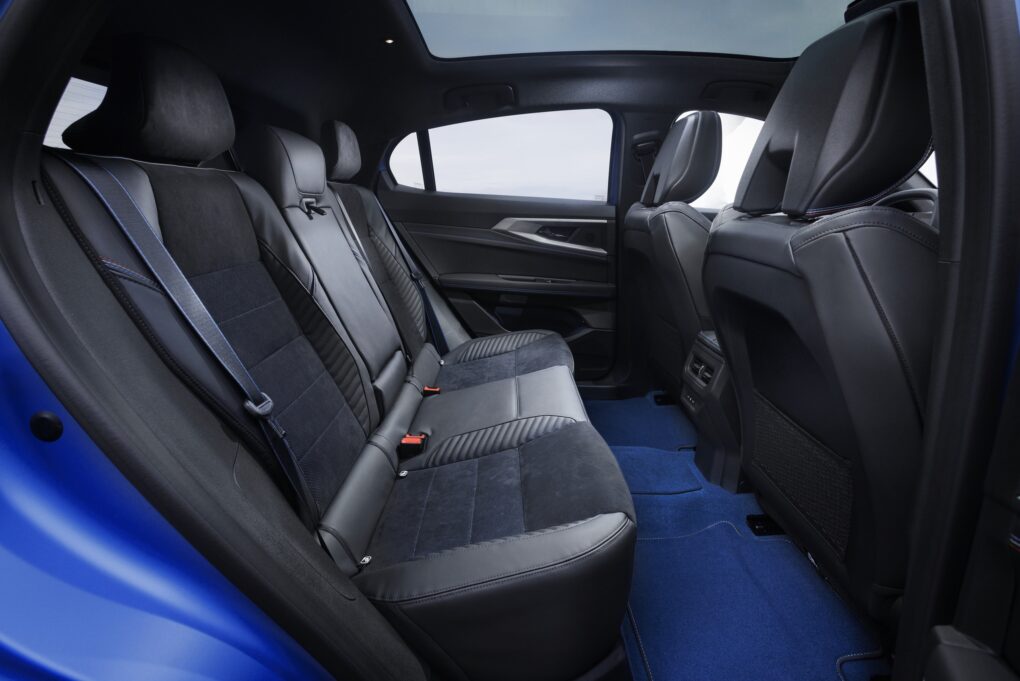
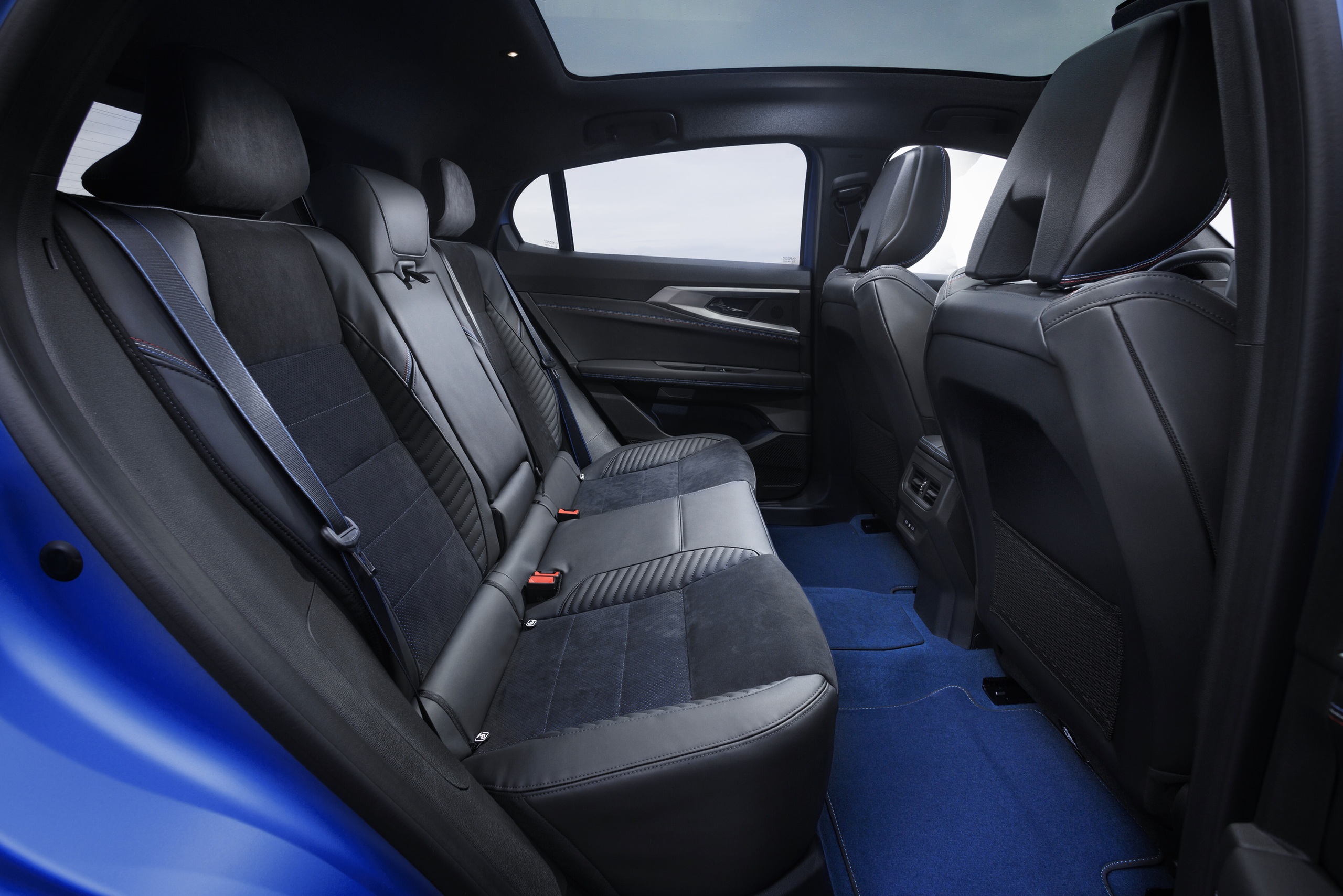
Herein lies one of the biggest surprises of the Renault Rafale. Despite its coupé-like sloping roofline, the rear seats offer a surprising amount of space. The long wheelbase of 2,74 meters provides 302 millimeters of legroom, which rivals the best in its class and allows even adults to travel comfortably on longer journeys. Renault has cleverly curved the roofline in such a way that headroom is largely preserved – a trick not every SUV coupé manages.
The Rafale can't completely defy the laws of geometry, however. Passengers taller than 1,90 meters will find their heads quite close to the sloping roofline in the rear. So, anyone who regularly travels with four very tall people should definitely try sitting in the back before buying. Up front, on the other hand, there's plenty of legroom, the seat height can be adjusted significantly, and the well-designed storage concept, featuring a rear armrest specifically for multimedia, including two USB ports and a fold-out tablet holder, makes the car a family-friendly travel companion. In direct comparison, the Rafale offers more rear legroom than a BMW X4, though it doesn't quite reach the station wagon-like spaciousness of a Peugeot 408.
-
- Image: Renault
-
- Image: Renault
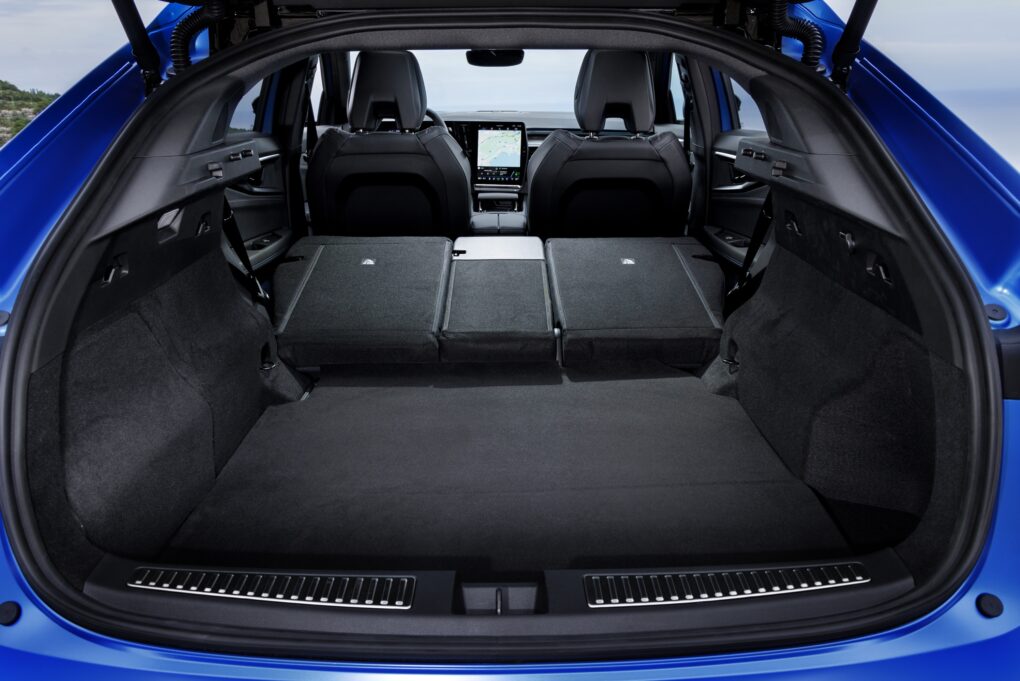
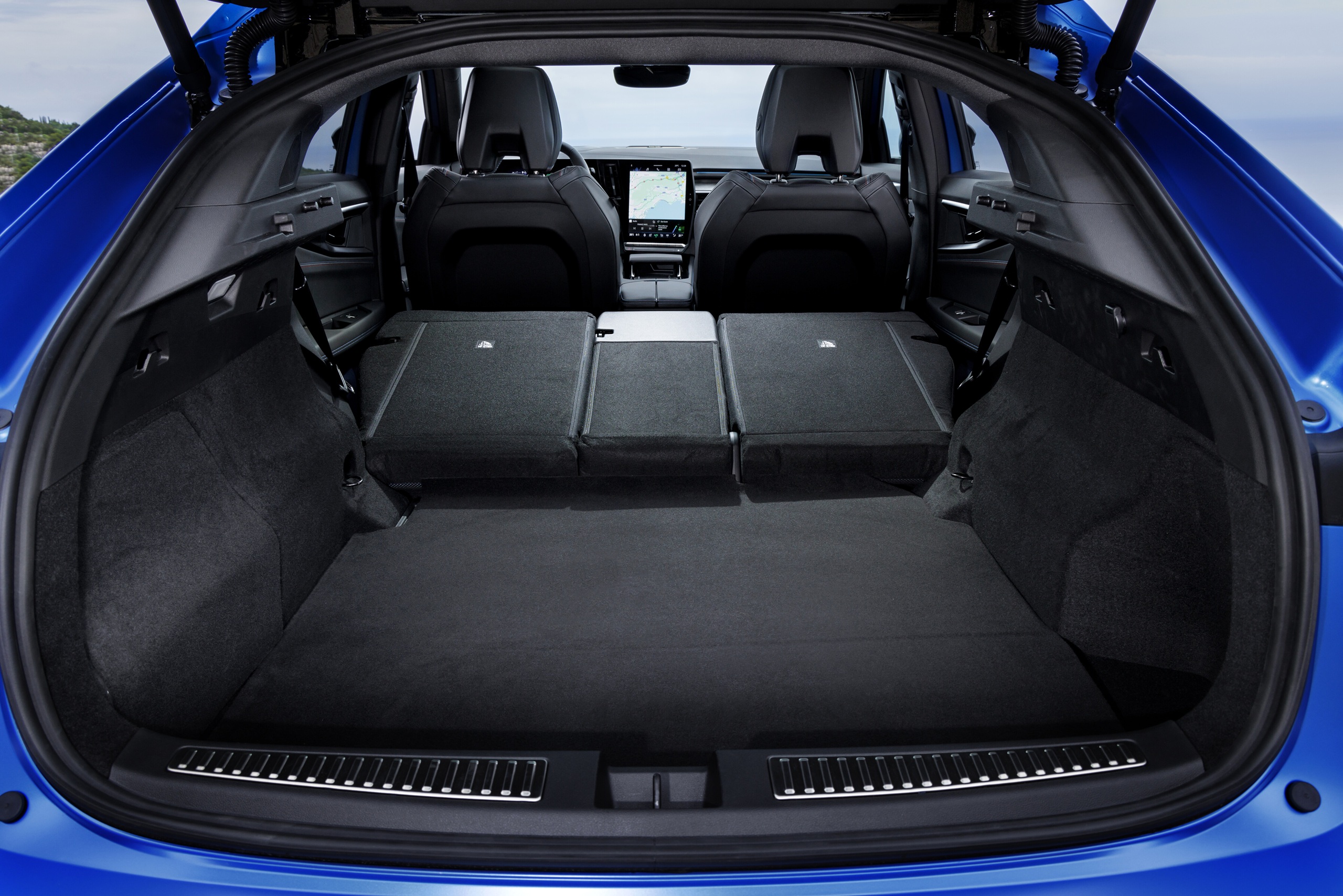
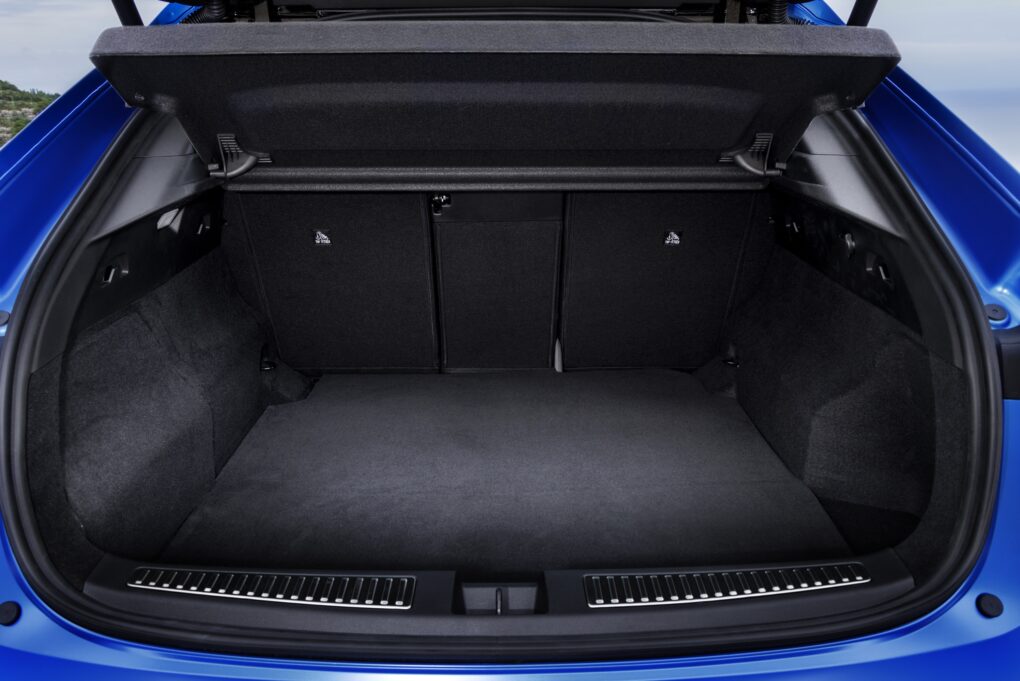
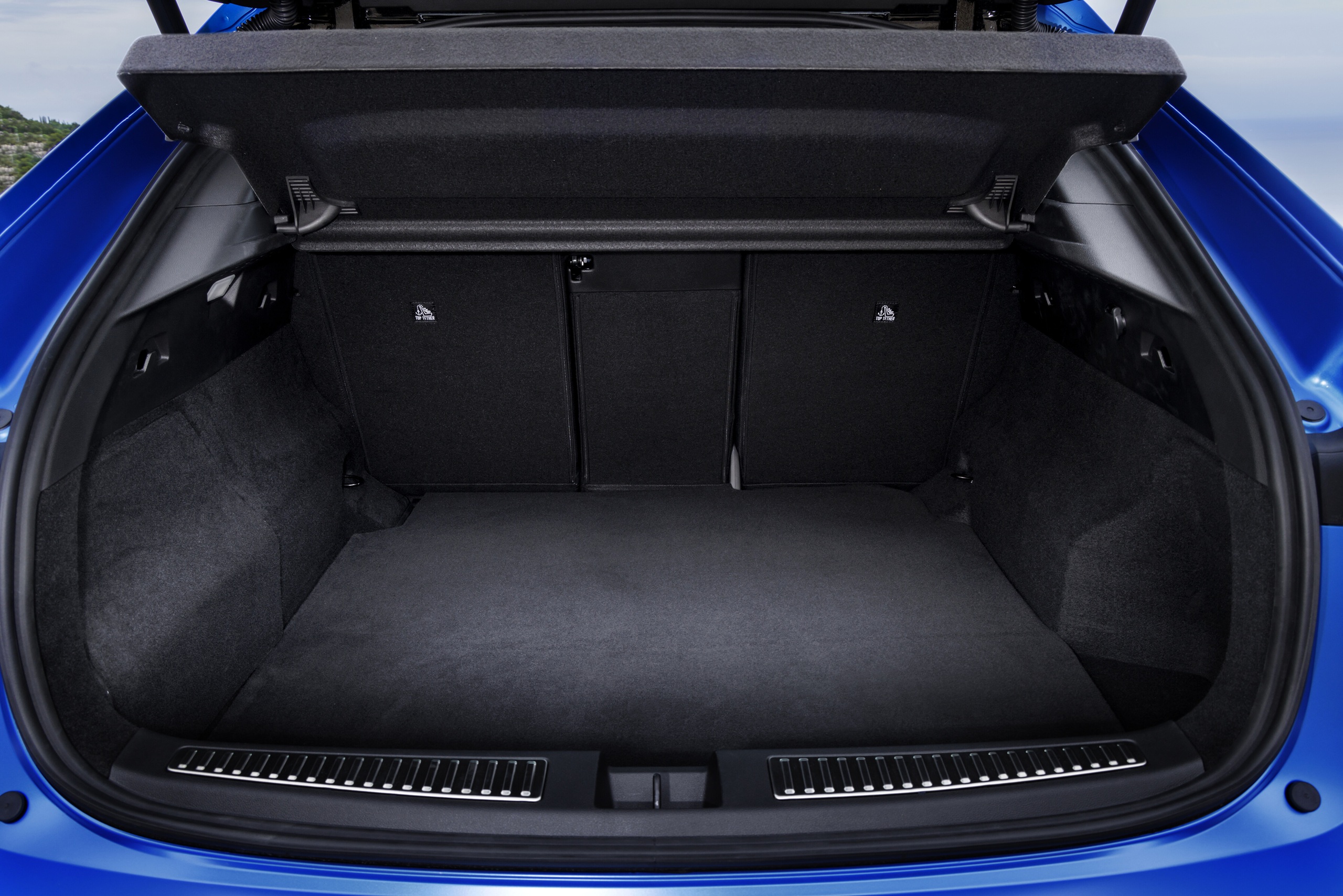
Boot capacity: 539 liters without battery compartmentproMiss
539 liters of cargo space is a confident statement, and it's honest, because unlike many others... Plug-in hybrids Renault has neatly integrated the 22 kWh battery into the vehicle floor, instead of squeezing it under the cargo area at the expense of luggage space. This means the Rafale PHEV is just as suitable for long journeys as its full hybrid siblings, which is not a given in this powertrain class. A weekend's shopping for a family of four disappears just as easily. proAs easy as luggage for a short break.
Renault has also considered practicality when it comes to accessories. QuickFix roof racks and an electrically folding tow bar significantly extend the vehicle's range. A bicycle carrier, for example, can be attached to the tow bar, and trailer stability control is standard. For a touch of luxury, customers can order a boot liner and Alcantara covers for the rear headrests. While the coupé design does mean sacrificing some maximum stacking height compared to a traditional station wagon, this rarely proves to be an issue in everyday use. The SUV coupé remains pleasingly practical.
-
- Image: Renault
-
- Image: Renault
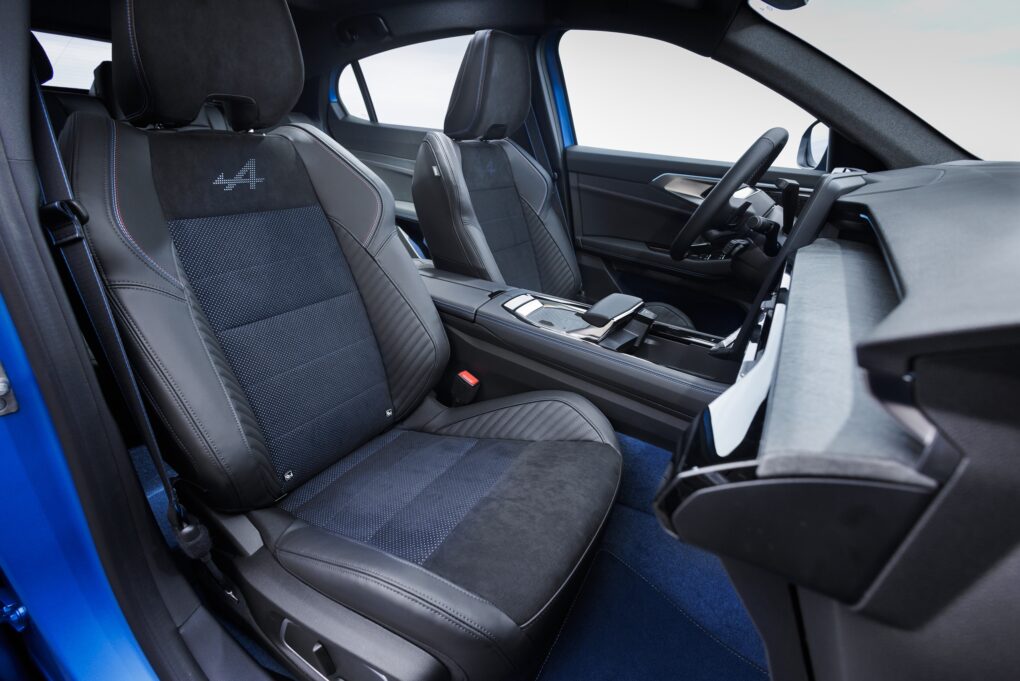
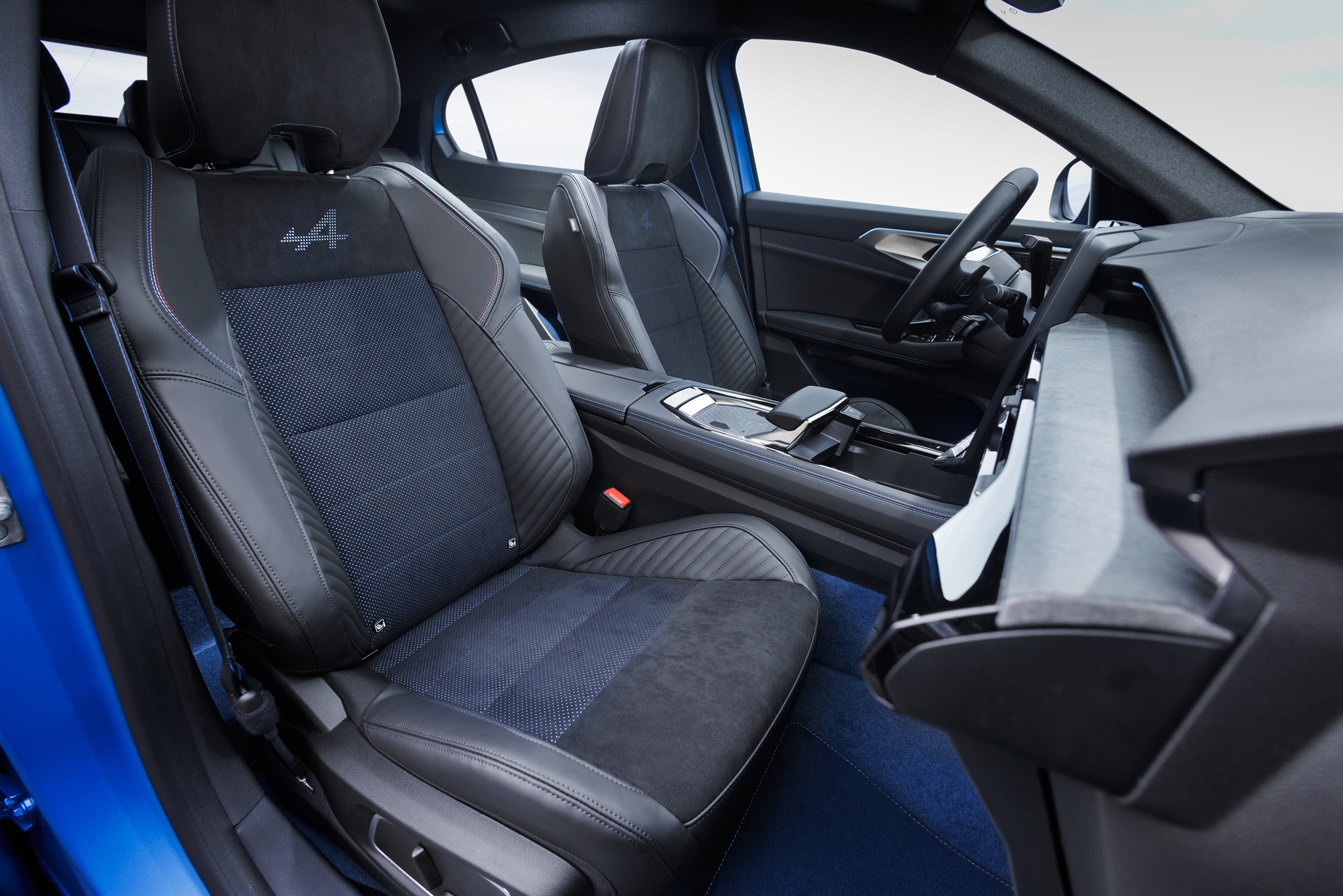
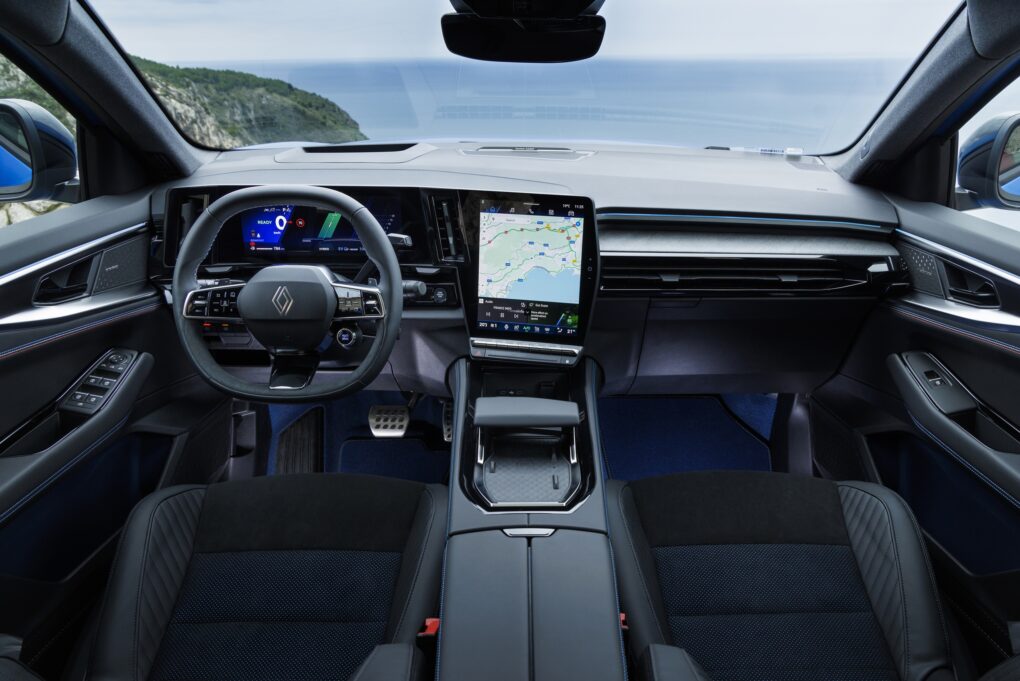
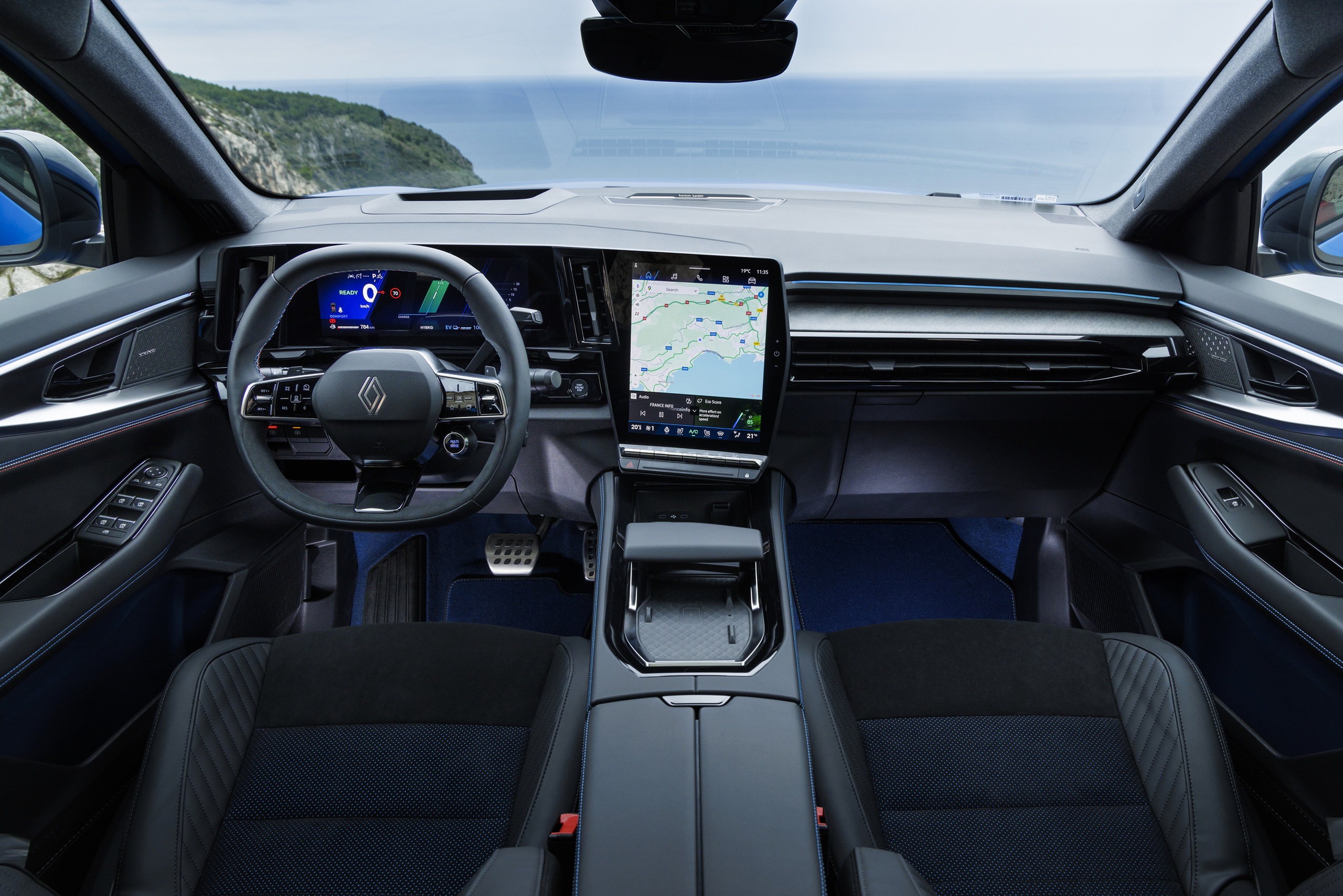
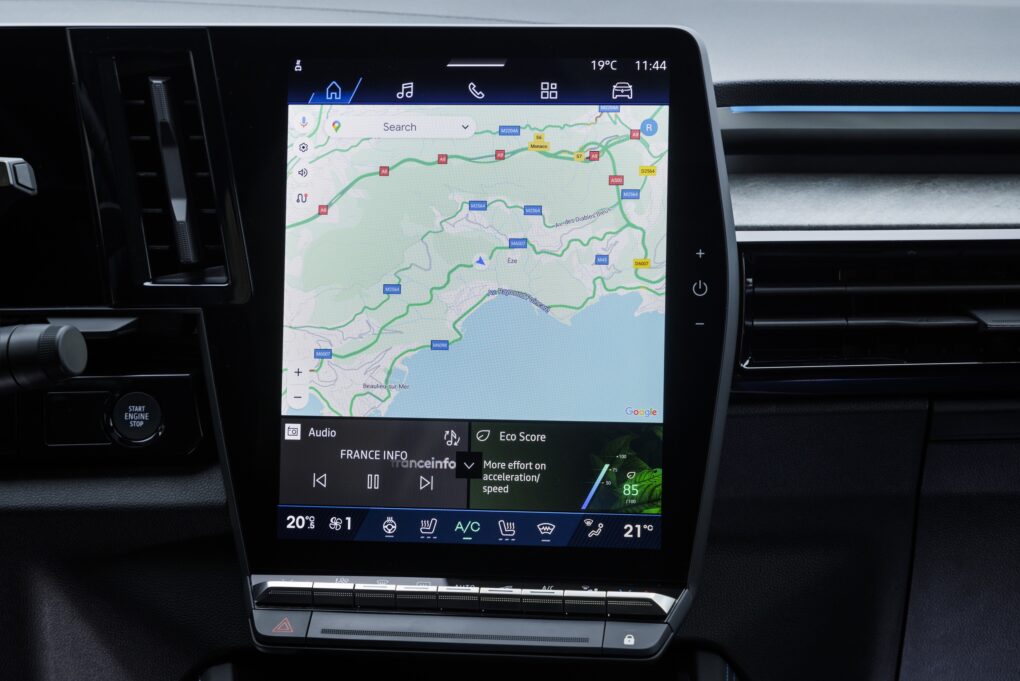
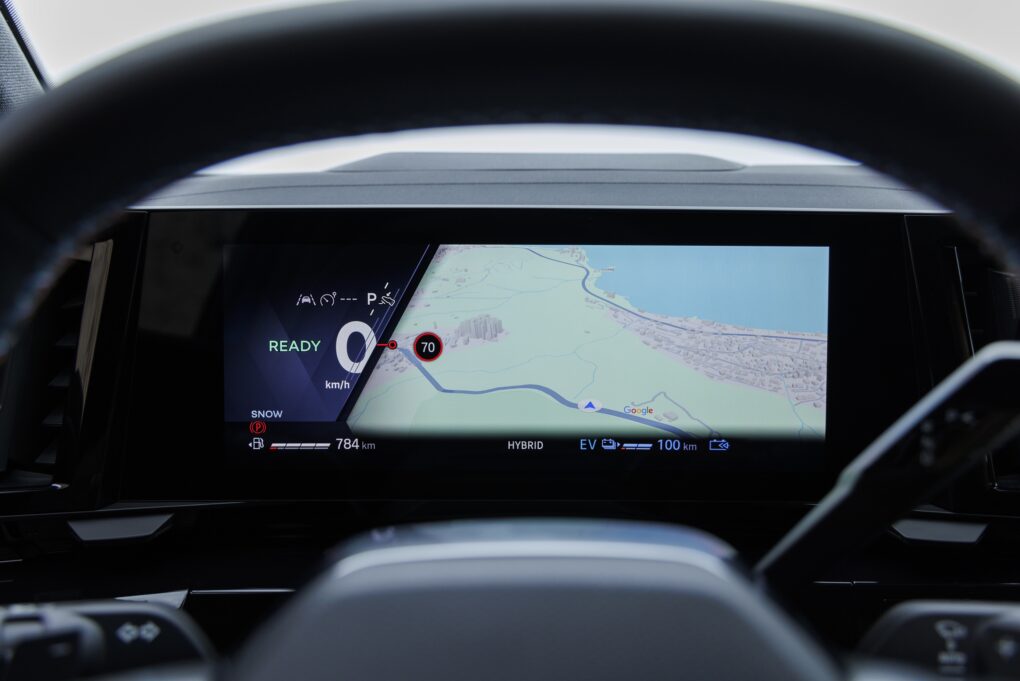
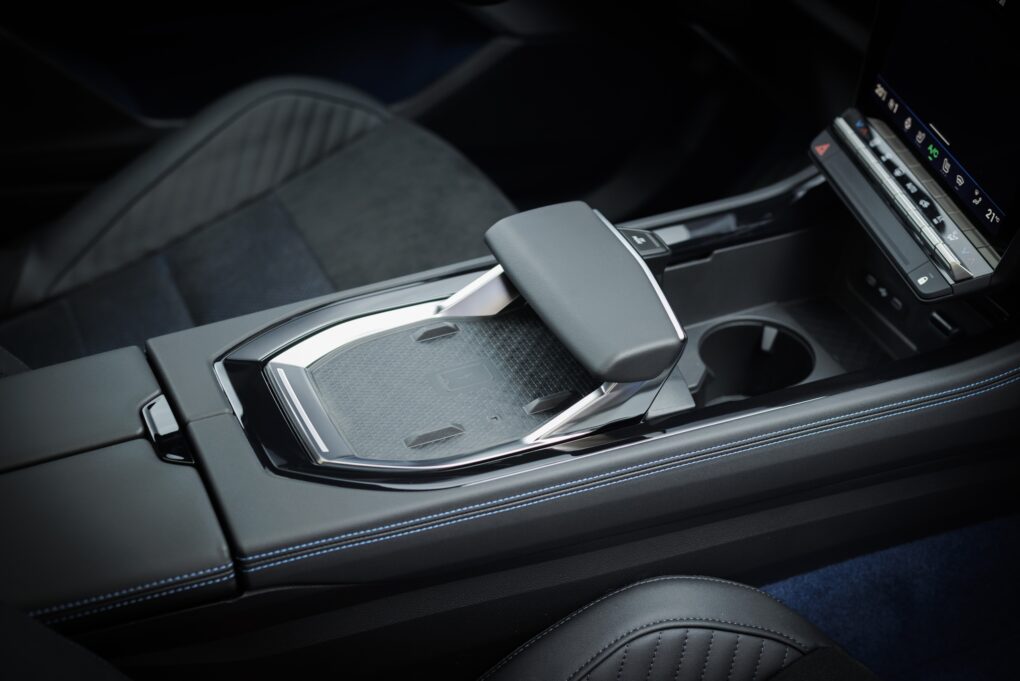
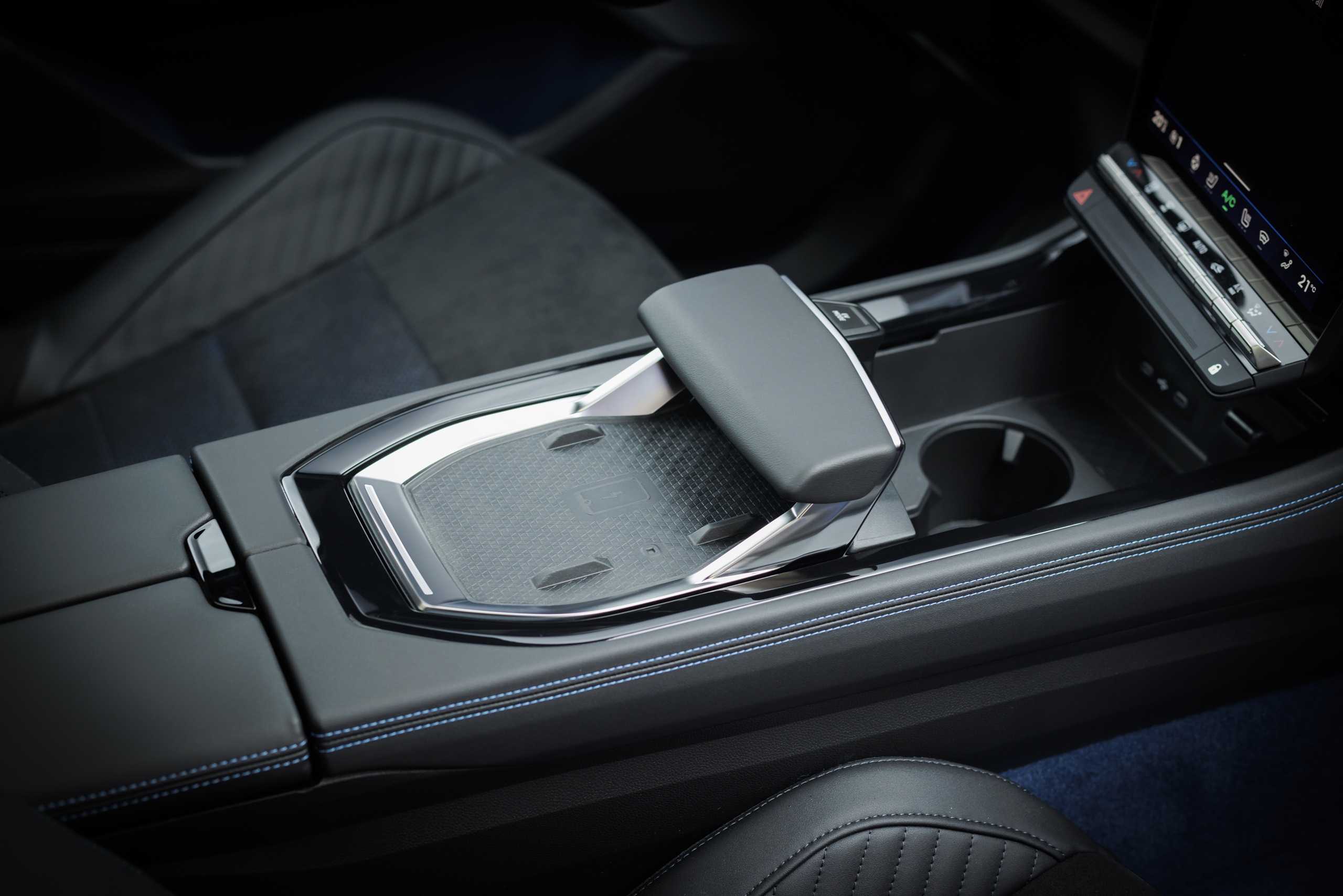
The premium aspirations continue in the cockpit, albeit with a few departures. The dashboard is dominated by the OpenR cockpit, featuring two L-shaped displays: a 12,3-inch landscape driver display and a 12-inch portrait touchscreen Above the center console, both are razor-sharp and quick to operate. Material quality and workmanship have made a noticeable leap compared to previous Renault generations – Alcantara, neatly stitched sports seats with tricolor seams, and the illuminated Alpine logo in the front seats create an ambiance that doesn't need to hide behind its German counterparts.
Completely without comproOf course, it can't be all bad. High-quality materials dominate the contact surfaces, but those who delve deeper will also encounter some harder plastic. Here you can see where Renault saved the approximately €15.000 price advantage over its German competitors. The physical buttons, which Renault has thankfully retained, for example for climate control and driving modes, are invaluable in everyday use and a welcome contrast to the touchscreen mania of other manufacturers. Overall, the interior is a place where you enjoy spending time – a true "car to live in," as the marketing department would put it, which is actually quite accurate here.
-
- Image: Renault
-
- Image: Renault
Infotainment & Connectivity: When Google Takes Over the Cockpit
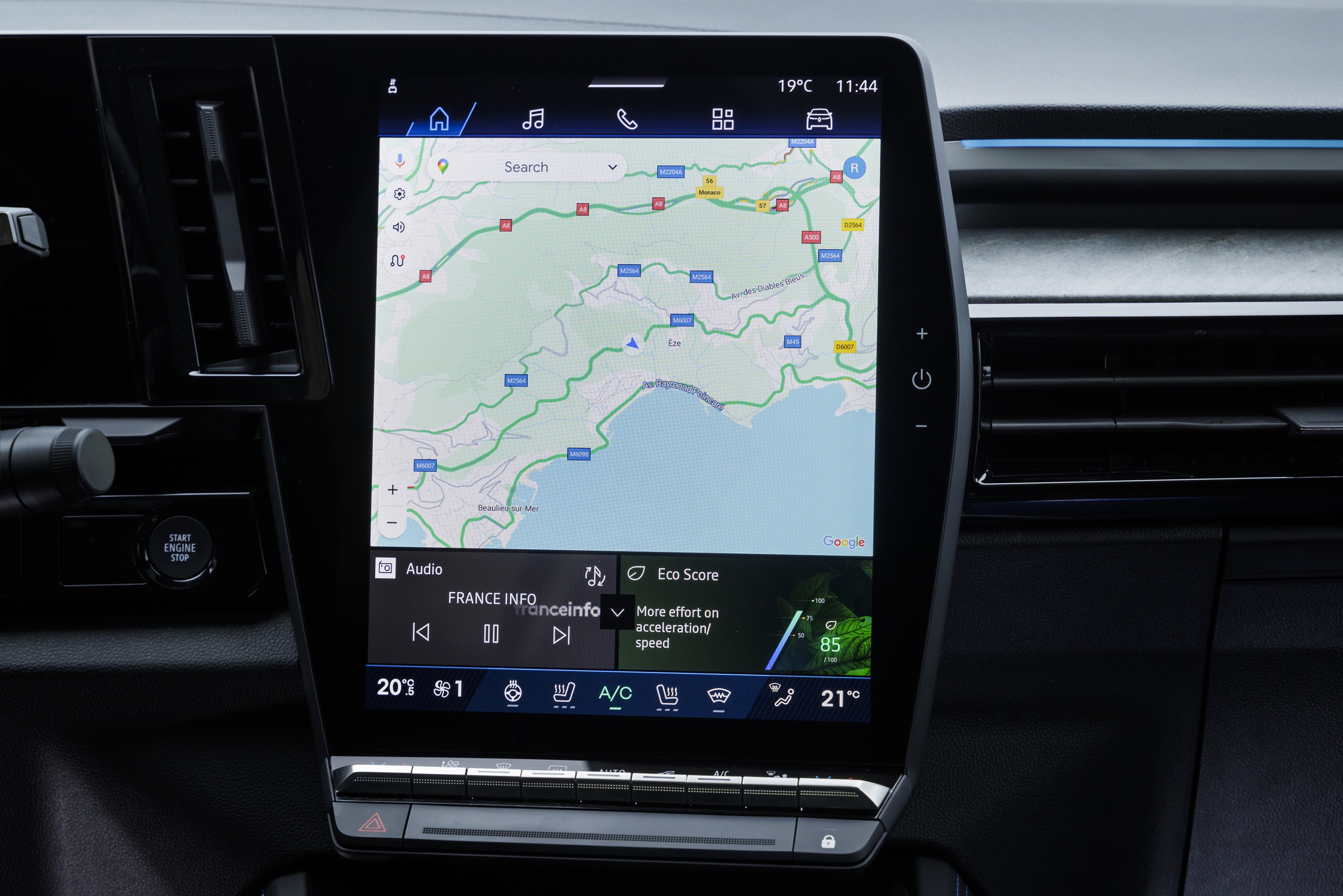
Renault is a leader in infotainment, and that's due to a clever decision: The OpenR Link system is based on Android Automotive 12Google isn't just a guest, but a fundamental component. Google Maps runs as the native navigation system, the Google Assistant responds to natural voice commands, and depending on the market, 50 or more apps can be installed directly in the car via the Play Store. The whole system operates as smoothly and logically as a good tablet – responsive, intuitive, without the lag that some German premium systems are known for.
Those who prefer their own smartphone can connect it wirelessly via Apple CarPlay or Android Auto, or alternatively via cable. In the rear, the aforementioned multimedia armrest features charging ports and device holders. The only drawback, which should be noted, is that Google services unfortunately become paid subscriptions after a certain period – a topic that is already generating discussion in relevant forums. In everyday use, however, the Renault Rafale's connectivity package is one of the better ones on the market and a compelling reason to choose the car.
-
- Image: Renault
-
- Image: Renault
Sound system: 485 watts from Harman Kardon
In terms of sound, Renault has given the top model a Harman Kardon system with 485 watts The car comes equipped with a sound system consisting of a front-mounted central unit, a subwoofer, four woofers, and surround speakers. Those who order it – it's standard or available as an option depending on the trim level – get a full, powerful sound with clean frequency separation and a spatial effect that works convincingly in the passenger compartment. For the vast majority of listeners, this is more than enough, and it suits the car's premium aspirations.
Audiophiles with absolute discerning tastes will certainly hear subtle differences in a direct comparison with top-of-the-line systems from Bowers & Wilkins or Burmester in the German luxury car segment, especially in the level of detail at high volumes. However, this is nitpicking at a very high level and almost petty for a car in this price range. In quiet electric mode, when there's no combustion engine to disturb the peace, the system truly shines. Then the Renault Rafale transforms into a surprisingly decent concert hall on wheels.
-
- Image: Renault
-
- Image: Renault
Driver assistance systems of the Renault Rafale E-Tech Plug-in Hybrid 300: 33 helpers and one clever button
Renault is making a big splash with its support staff: There are 33 driver assistance systems on board.From adaptive cruise control with stop-and-go functionality and active emergency braking with intersection function to a 3D around-view monitor with a bird's-eye view for millimeter-precise parking, the system offers a comprehensive suite of features. At its heart is Active Driver Assist, a Level 2 semi-autonomous system that combines adaptive cruise control and lane keeping assist and – unlike many competitors – functions not only on highways but on all types of roads. Using geolocation data from the navigation system, the car proactively adjusts its speed to curves and roundabouts, a feature that works surprisingly well in everyday driving.
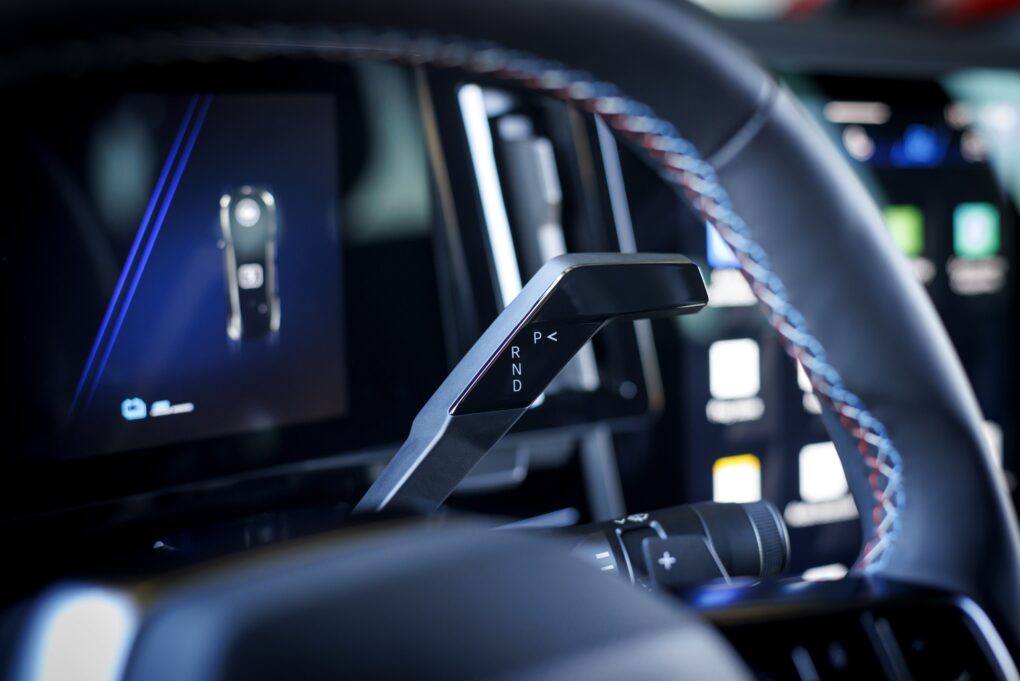
The My Safety Switch, a dedicated button on the left of the steering wheel, is particularly well-designed. Since the EU regulation GSR2, certain driver assistance systems, such as the intrusive speed warning, must be active every time the vehicle is started. Instead of navigating through menus, the Renault Rafale allows you to save your preferred settings for five systems and activate them with a single press of a button. Every manufacturer should take note of this small solution to a major annoyance. In addition, there's the Safety Score and the award-winning Safety Coach, which assess your driving style and provide personalized tips – well-intentioned, but in our test more of a gimmick than a genuine benefit.
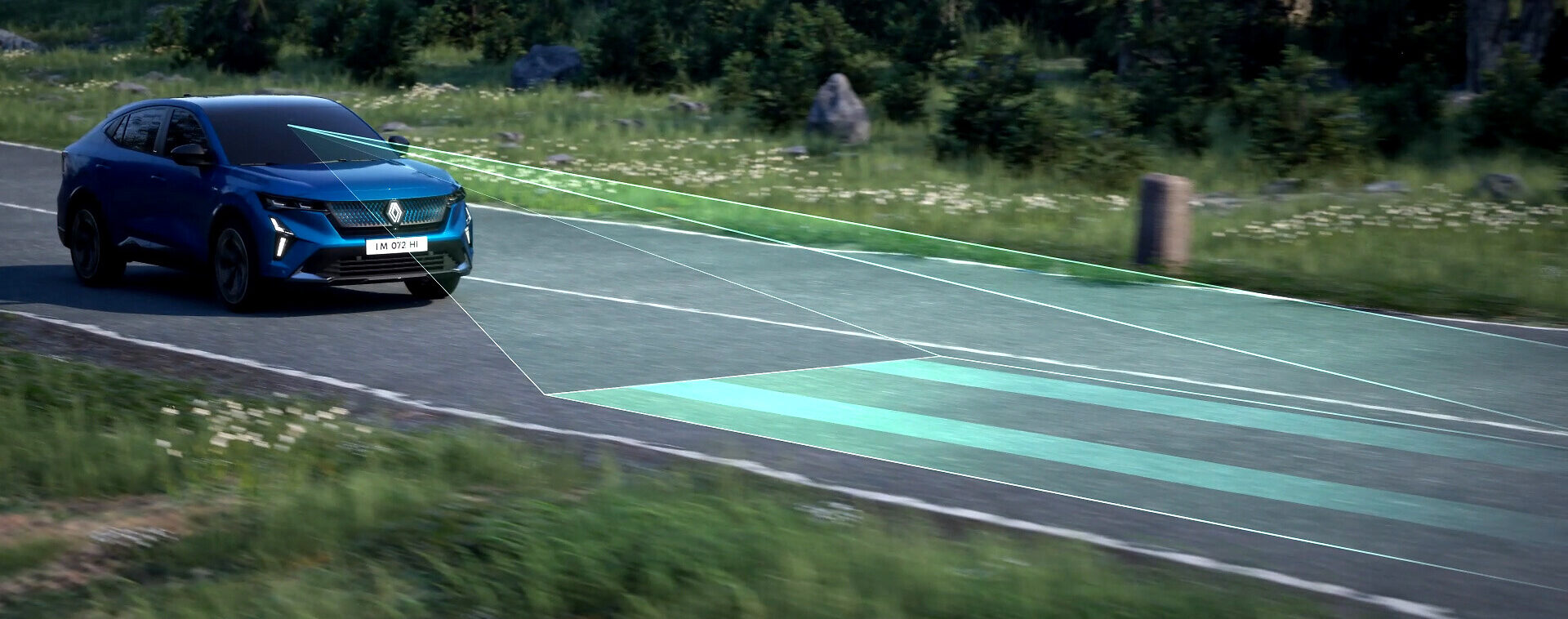
Image: Renault
Comfort: Tightly tuned
And here comes the first, clear damper, both literally and figuratively. Anyone expecting a French sedan chair from the top-of-the-line Atelier Alpine model is mistaken. As soon as Alpine has a hand in it With 21-inch wheels featuring low-profile tires, the basic suspension setup is firm, even in Comfort mode. Short bumps, transverse joints, and poor asphalt are noticeably transmitted to the occupants. This isn't a criticism, but a deliberate design choice. The Rafale aims to be a car with sporty aspirations, not a rolling living room.
What's remarkable is how well the predictive, camera-based damper control mitigates this fundamental conflict. A camera behind the windshield scans the road ahead and adjusts the shock absorbers in milliseconds to what's coming. This is a technology previously only found in luxury cars. Bumps and larger road imperfections lose their terror, and the car remains remarkably composed and stable even on rough surfaces. Ultimately, the Rafale is more comfortable than its firm basic setup would suggest, though never exceptionally soft. Those who find it too firm can opt for the Esprit Alpine version with 20-inch wheels.
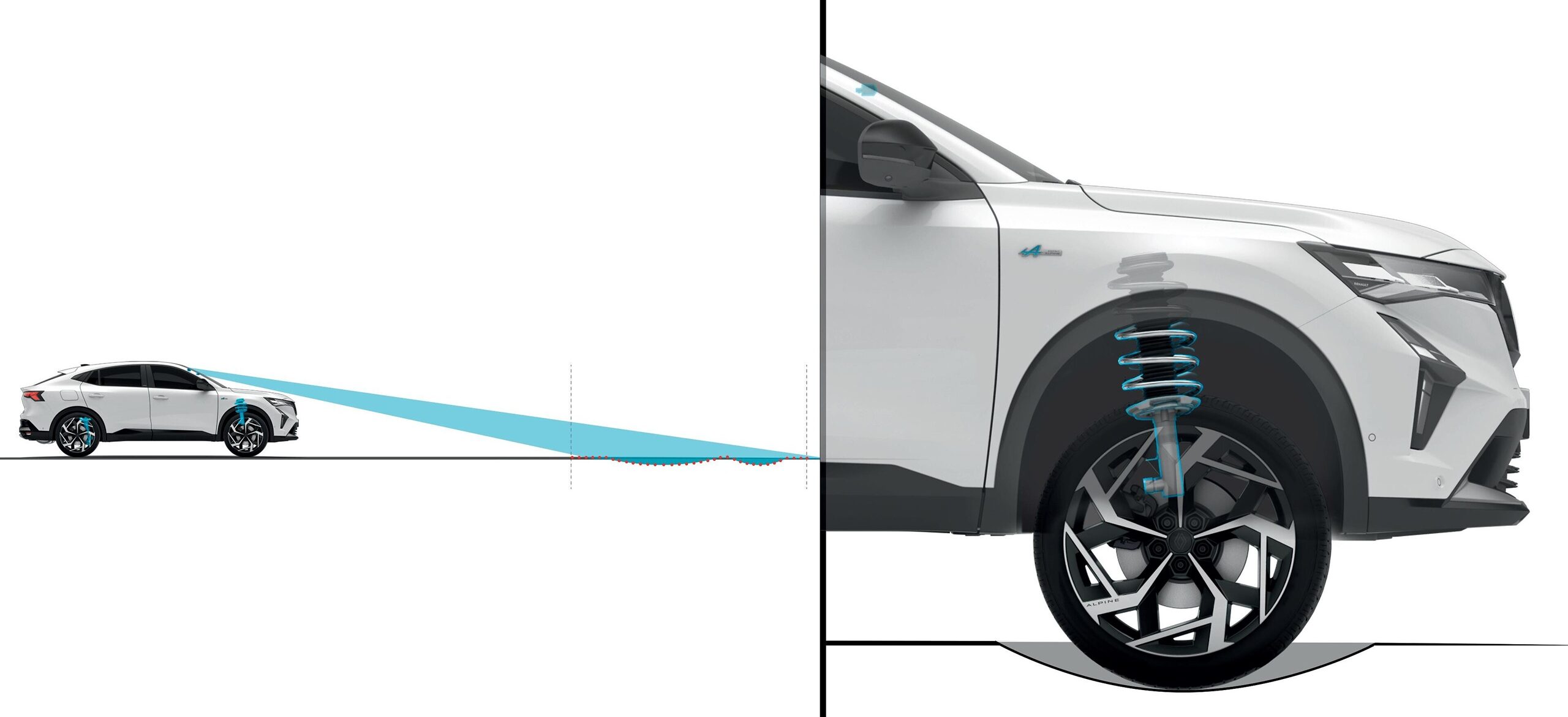
Image: Renault
Security: Five-star standard
Regarding security proThe Rafale is adapted from its corporate relatives. The technically closely related Renault Austral already won the Full five stars in the Euro NCAP crash test with strong individual ratings for the protection of adults, children, and pedestrians. These are qualities that the Rafale can confidently deliver. The comprehensive suite of driver assistance systems, especially the standard emergency braking system with cross-traffic and reverse functions, contributes significantly to both passive and active safety.
One feature deserves special praise: the drive battery is equipped with the Fireman Access System, developed in collaboration with firefighters. Through a defined opening, emergency responders can direct extinguishing water into the battery's interior in the event of a fire, thus bringing a battery fire under control much more quickly. This detail can save lives in an emergency and demonstrates that Renault brings over a decade of experience in electromobility to the table when it comes to high-voltage safety. Naturally, no definitive judgment can yet be made regarding the long-term reliability of a model introduced in 2024.
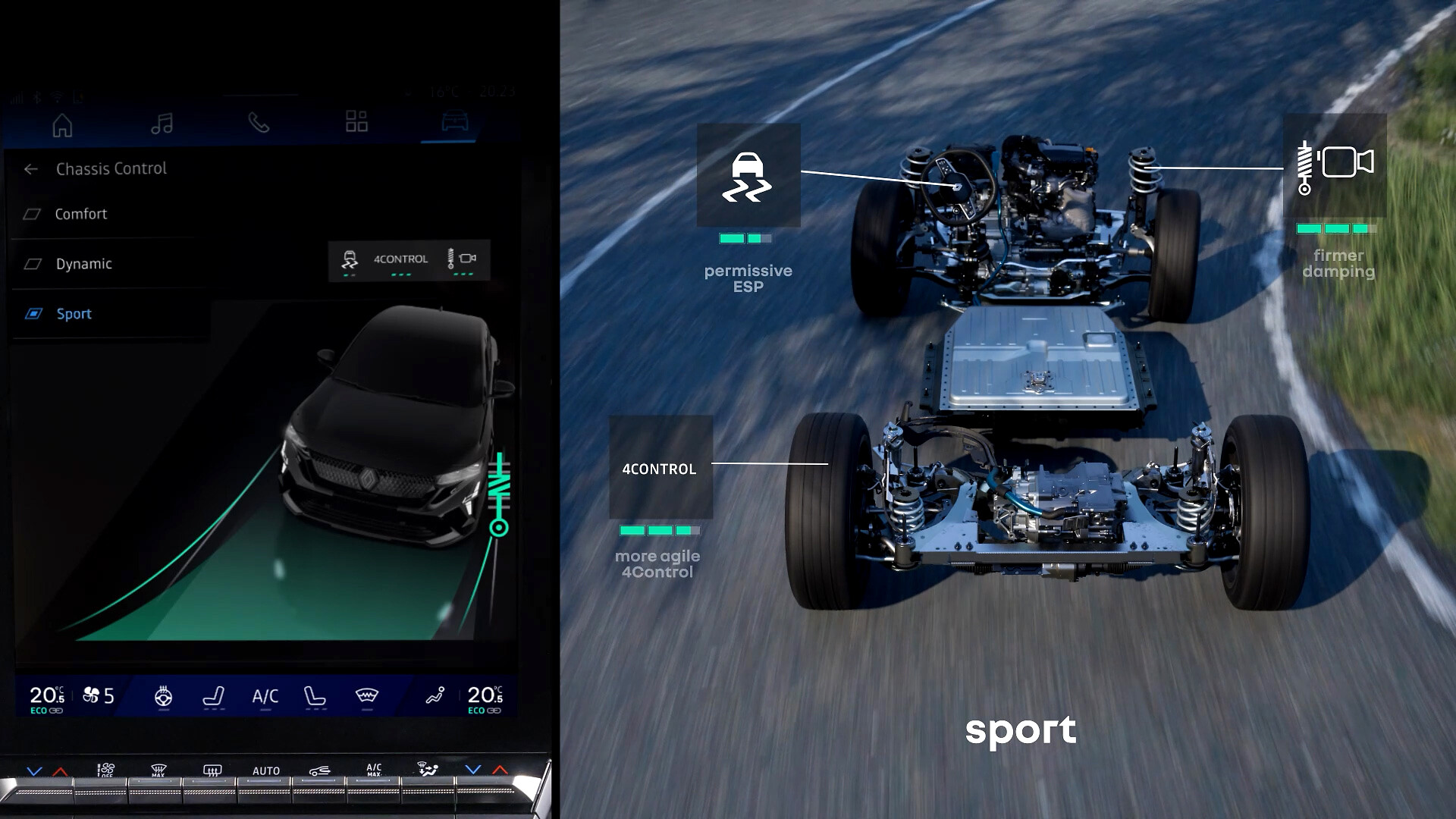
Image: Renault
The Renault Rafale E-Tech Plug-in Hybrid 300's powertrain: Four motors, 300 hp – and one small catch.
The powertrain incorporates all of the brand's high-tech expertise and a fascinatingly complex system. It's based on a 1,2-liter three-cylinder turbocharged gasoline engine producing 150 hp and 230 Nm of torque. This is complemented by three electric motors: a 70 hp motor on the front axle, a 136 hp electric motor on the rear axle, and a 34 hp high-voltage starter-generator that ignites the combustion engine, orchestrates the gear changes of the multi-mode automatic transmission, and charges the battery. The result is a System output of 300 hp (221 kW) and a permanent, intelligently controlled all-wheel drive system that continuously shifts power between the front and rear axles depending on the situation. The performance figures are impressive: 0 to 100 km/h in 6,4 seconds, and the flexible intermediate sprint from 80 to 120 km/h is achieved in just 4,0 seconds.
As impressive as it sounds on paper, one must also be honest about its limitations. With a fully charged battery, the Rafale is a swift, refined cruiser that feels like an electric car with a range extender – silky smooth acceleration, no shift jolts, and a refined quietness. But when the battery is empty and you demand full power on the motorway at cruising speed, the illusion collapses: then the small three-cylinder engine has to haul the nearly two tons on its own, growling unrefinedly under load and becoming quite audibly present. During hard kickdown, the complex transmission occasionally takes a brief moment to process the power. Anyone accustomed to the vibration-free smoothness of a BMW inline six-cylinder will likely be disappointed. However, in relaxed everyday driving, which is what the car is designed for, the powertrain fully demonstrates its strengths.
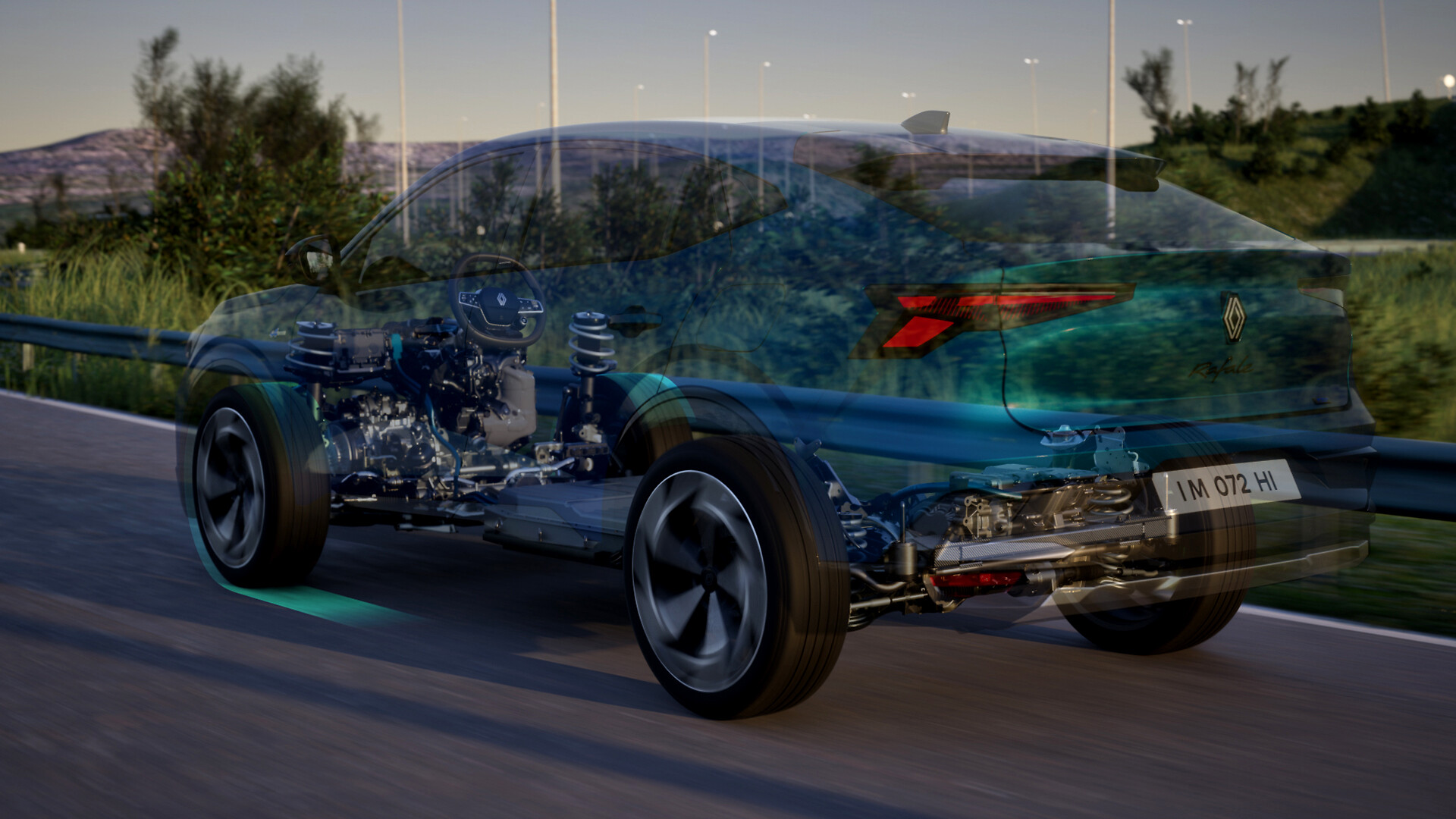
Image: Renault
Driving dynamics and handling: When Alpine is in charge
This is where Alpine's efforts pay off. Around a dozen engineers from Alpine Cars spent three years fine-tuning the chassis: specific dampers, springs and stabilizers, camera-based adaptive damping control, specially calibrated control units, and last but not least, the standard all-wheel steering. 4Control advanced, which allows the rear wheels to steer by up to five degrees. The result is astonishing: A 4,71-meter SUV weighing nearly two tons handles as nimbly and agilely as a much smaller car, steers sharply and directly, and remains remarkably level even in fast corners. In tight bends, the rear-wheel steering noticeably reduces the turning circle, and at higher speeds, it provides stability.
The Rafale's exclusive Chassis Control system combines its many talents – four motors, all-wheel drive, all-wheel steering, regenerative braking, and adaptive damping – into three driving modes: Comfort, Dynamic, and Sport. In Sport mode, the system sharpens steering and throttle response, reduces body roll, and prioritizes power distribution at low speeds, giving the Rafale a hint of rear-wheel-drive feel. To be honest, even Alpine can't magically erase its nearly two tons. You can feel the mass during very rapid load changes. But for an SUV coupé of this size and price, the dynamics it offers are simply in a class of their own. A BMW X4 is hardly more composed, and a Cupra Formentor isn't any more poised.
-
- Image: Renault
-
- Image: Renault
Battery: 22 kWh that makes the difference
The core of the efficiency is a lithium-ion battery with 22 kWh capacity and 400-volt architectureThe battery is installed flat in the vehicle floor. This gives the Rafale PHEV a significantly larger energy capacity than many competitors, whose plug-in batteries often only hold between 12 and 18 kWh. This is a key reason for its above-average electric range compared to other vehicles in its class. The battery powers the two main electric motors and can be charged in three ways: via a wall socket, while driving using the combustion engine as a generator, or through regenerative braking.
AproPositive recuperation: Brake energy recuperation can be adjusted in four stages via the steering wheel paddles, from free coasting to strong deceleration, enabling almost one-pedal driving in city traffic, similar to a pure electric vehicle. This is not only efficient but also surprisingly enjoyable and reduces the workload on the brakes. The manufacturer offers an eight-year or 160.000-kilometer warranty on the battery, guaranteeing at least 70 percent of its original capacity. This is a solid, industry-standard figure that alleviates the biggest concerns for long-term buyers.
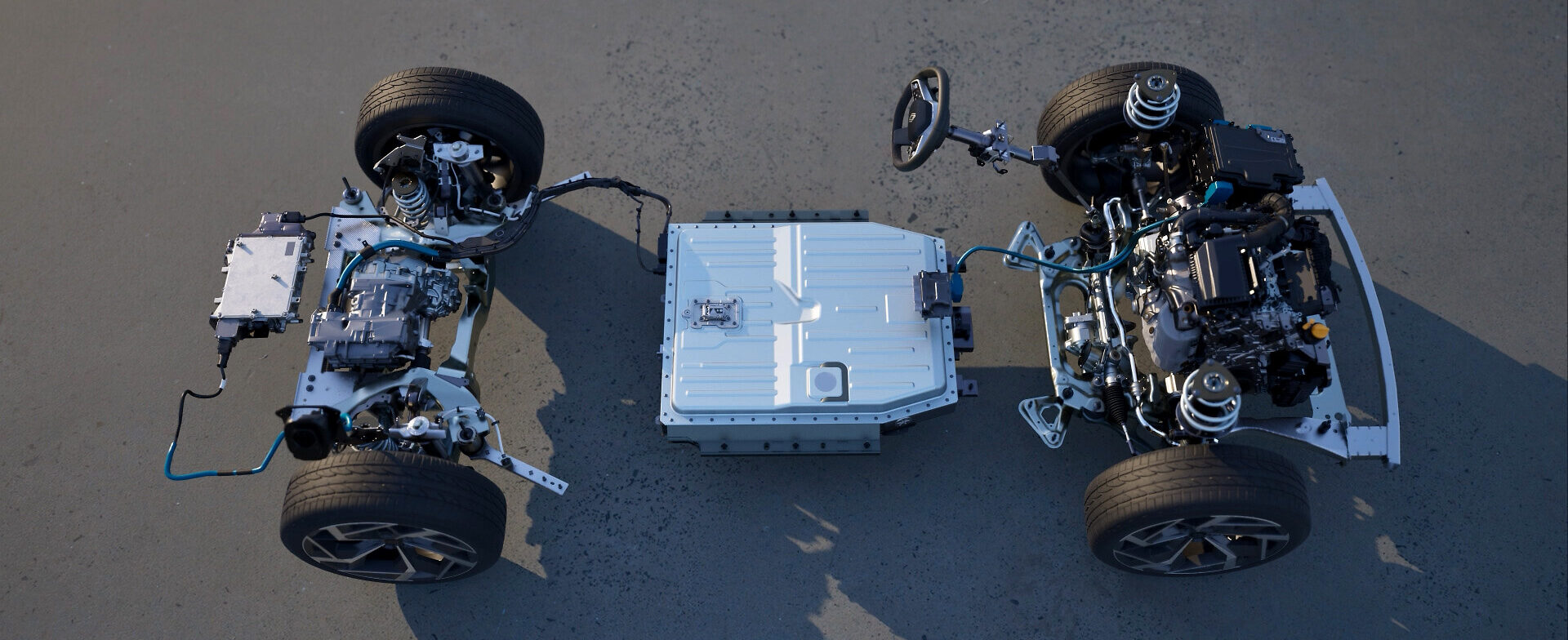
Image: Renault
Fuel consumption of the Renault Rafale E-Tech Plug-in Hybrid 300: WLTP meets real-world figures
Let's turn to the figures, where plug-in hybrids traditionally play tricks. Renault quotes a weighted WLTP figure of 0,6 l/100 km plus 22,7 kWh of electricity, a laboratory value that is only approximately achievable if you consistently charge the car and drive predominantly in electric mode. If you don't do this and drive with an empty battery, the manufacturer claims 6,2 l/100 km. That's not a bad figure for a car of this size and performance, but it's certainly not a sure thing. After all, those nearly two tons need to be moved, and the small three-cylinder engine has to work.
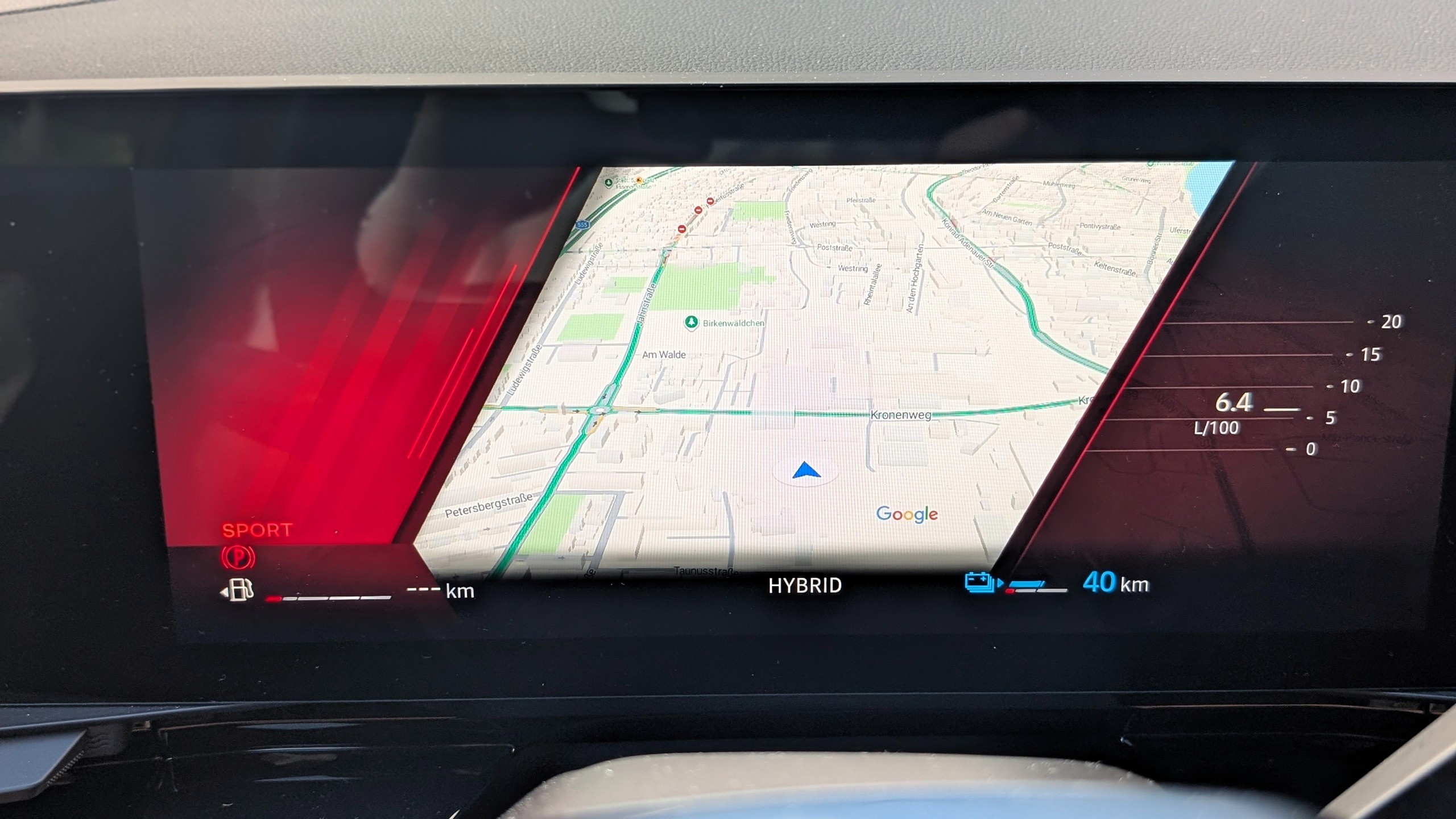
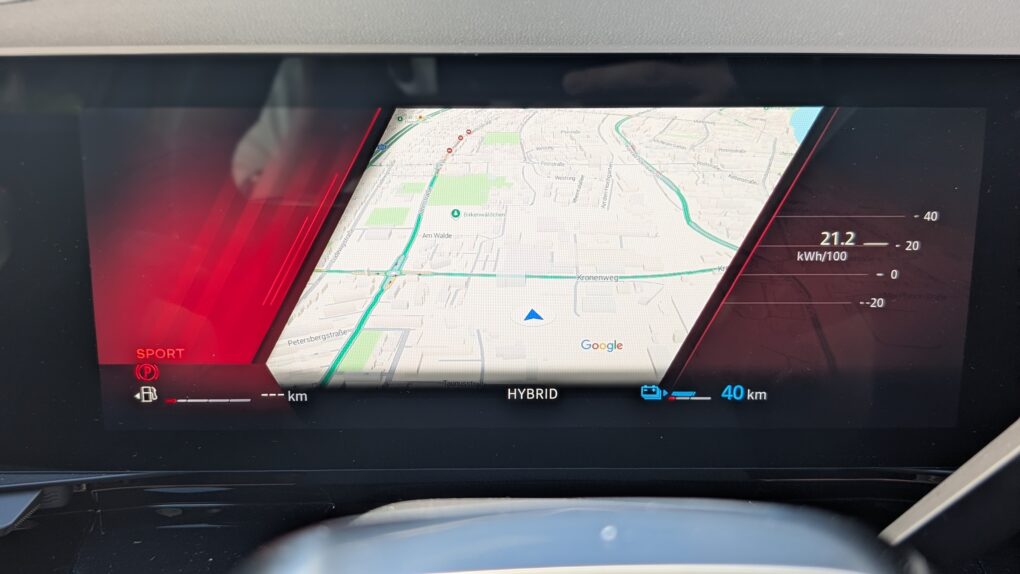
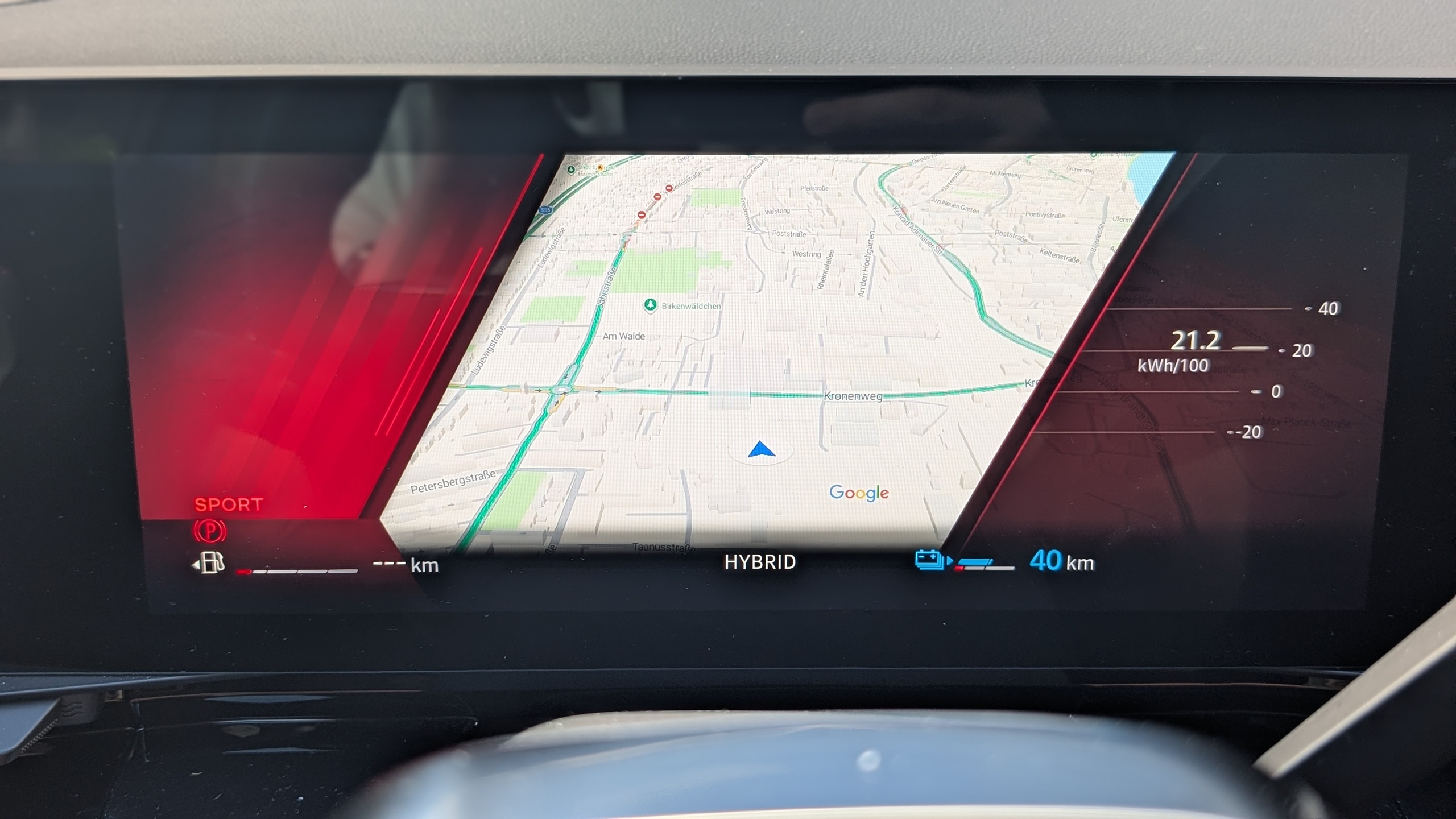
Our experience shows that on mixed terrain with a partially charged battery, around 5,0 l/100 km plus almost 21 kWh of electricity realistic figures. On the motorway with an empty battery and at a speed limit of 130 km/h, the Rafale consumes about 6,4 liters per 100 km, while in city traffic with a full battery, it practically cruises along without using any fuel. So, anyone who uses the car as intended – short trips electrically, long trips in hybrid mode – will drive surprisingly economically. However, anyone who misuses it as a purely combustion-engine vehicle is wasting 22 kWh of battery weight as extra weight.
Range: Up to 1.000 kilometers without refueling
The Rafale's electric range is its biggest strength. Renault quotes up to 105 kilometers according to WLTP for the Esprit Alpine version. In the top-of-the-line Atelier Alpine variant tested here, with its large 21-inch wheels, the manufacturer claims 97 kilometers. Realistically, depending on speed, topography, and outside temperature, one should expect a more realistic range. 75 to 85 kilometers Calculate and even that covers the commuterproThe vast majority of drivers can easily handle the load. This puts the French car clearly ahead of many competitors, whose smaller PHEV batteries often only deliver 40 to 60 real-world kilometers.
Combined with the 55-liter gasoline tank, this results in a theoretical total range of up to 1.000 kilometers. A figure that Renault likes to prominently highlight, and one that is actually achievable under favorable conditions. This is the true strength of the concept: no range anxiety, no searching for charging stations on a holiday trip to the South of France, but instead, in everyday life, the clean conscience and smooth running of a pure electric vehicle. Those who charge at home or at work effectively drive electrically in everyday situations and only fill up with gasoline for the few long journeys they make each year.
-
- Picture: TechnikNews
-
- Picture: TechnikNews
Charging: Single-phase with 7,4 kW – is that sufficient for everyday use?
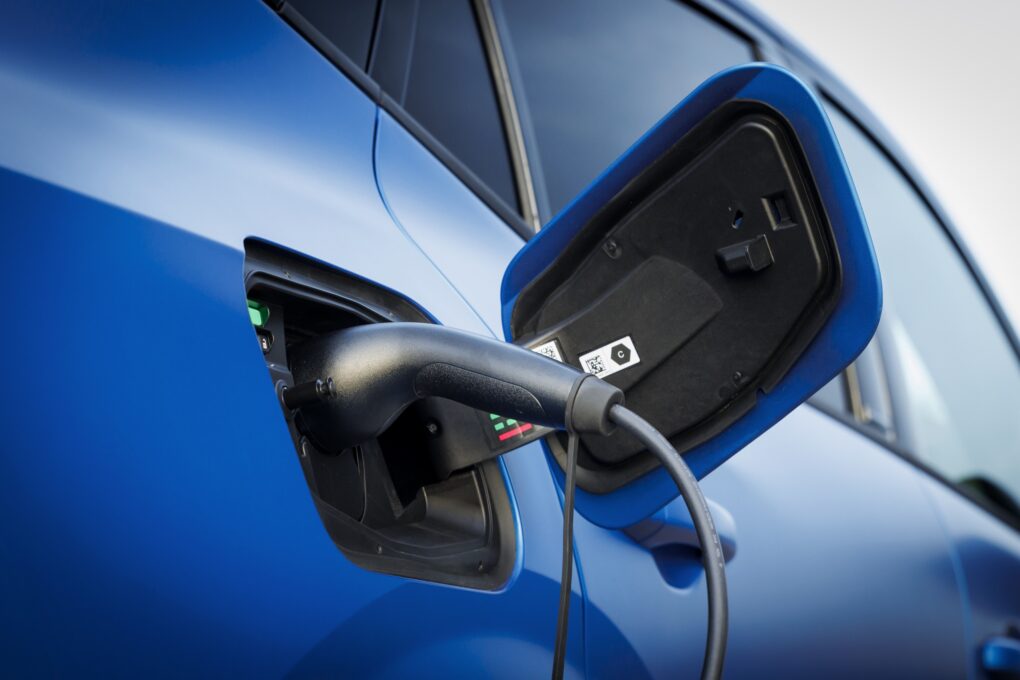
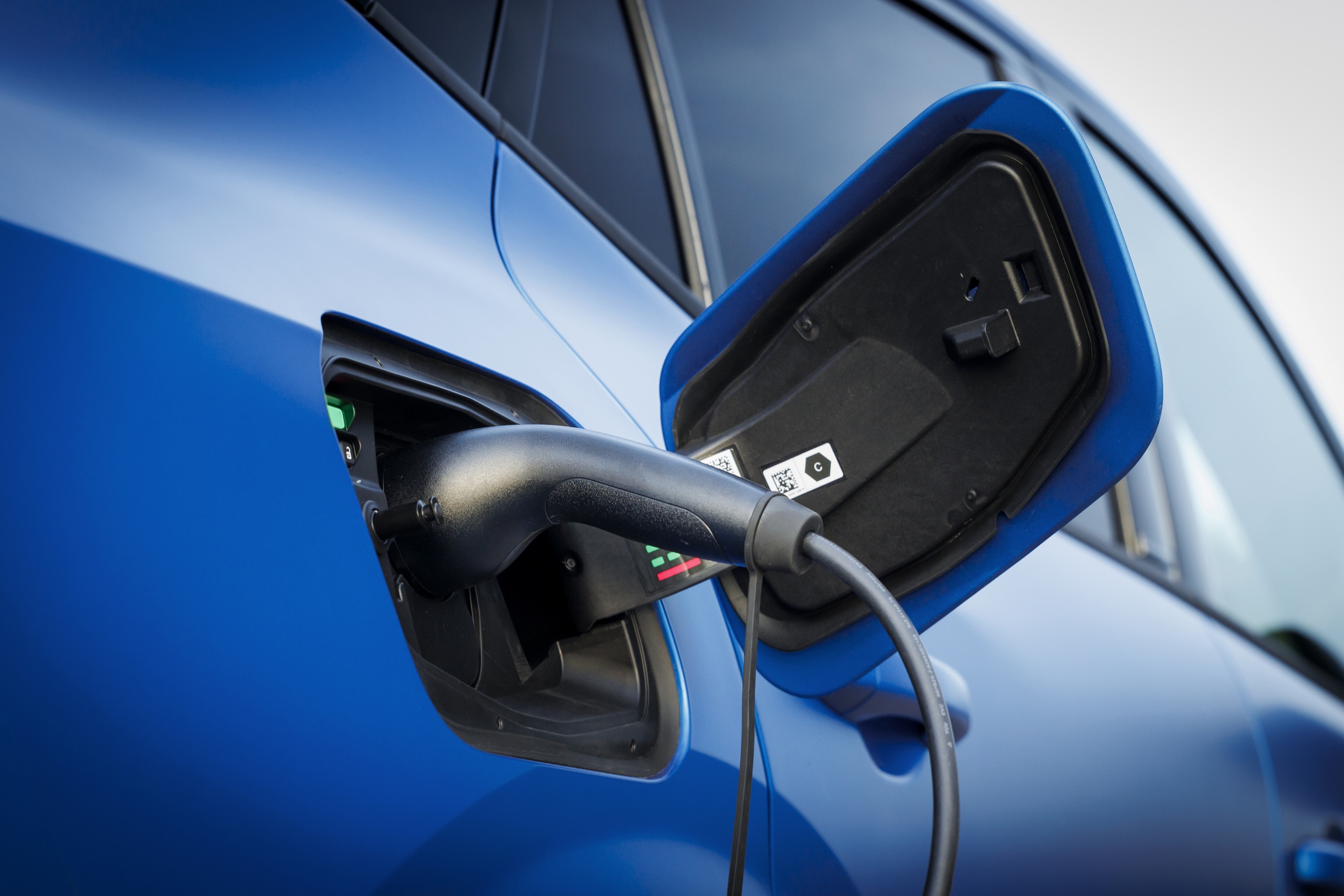
The Renault Rafale's charging capabilities are a mixed bag. It only charges via single-phase AC with a maximum of 7,4 kW. There's no DC fast-charging function, which, while forgivable for a plug-in hybrid in this price range, isn't a given. The 22 kWh battery can be charged at a wallbox or public charging station. approximately 2 hours 10 minutes at 80 percent and completely filled in approximately 2 hours and 55 minutes.
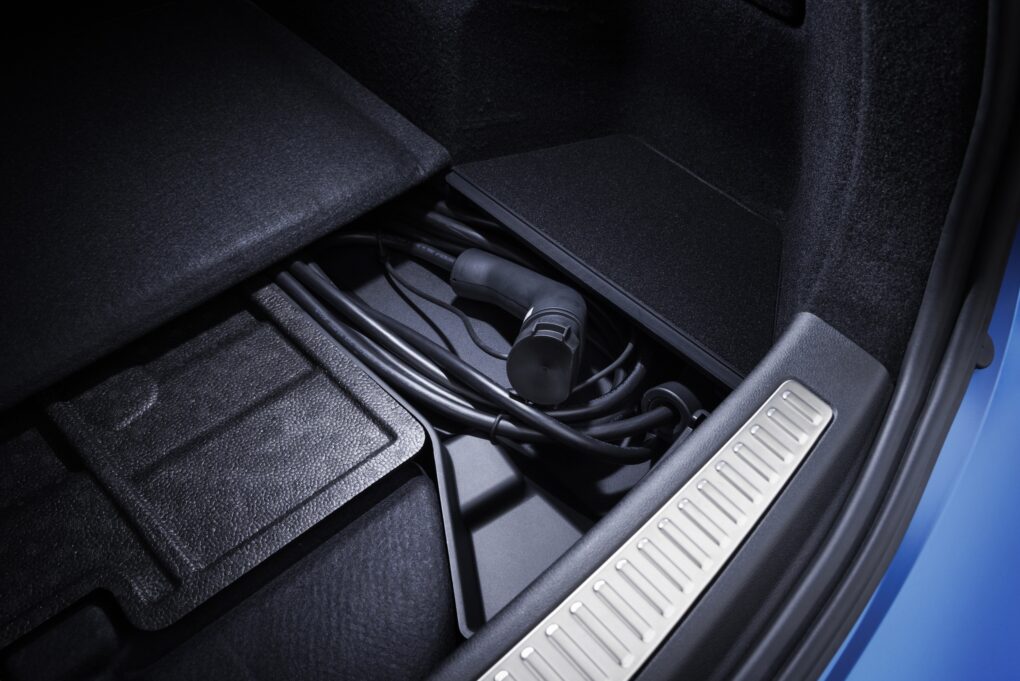
In everyday use, this perceived weakness quickly becomes less of an issue. If you plug the car into your home wallbox overnight, you'll start each morning with a full battery. The charging speed then simply doesn't matter. However, charging takes around nine hours using a standard 2,3 kW household outlet and almost five and a half hours using a 3,7 kW Green-up outlet. Renault includes the appropriate charging cable as standard. It's important to know that only those who charge regularly will get the most efficiency out of the Rafale PHEV. As a purely combustion-engine replacement vehicle without charging options, the concept makes little sense. In that case, the simpler 200 full hybrid is a better choice.
-
- Image: Renault
-
- Image: Renault
Price & Warranty of the Renault Rafale E-Tech Plug-in Hybrid 300: Significantly cheaper than the BMW X4 and Audi Q5
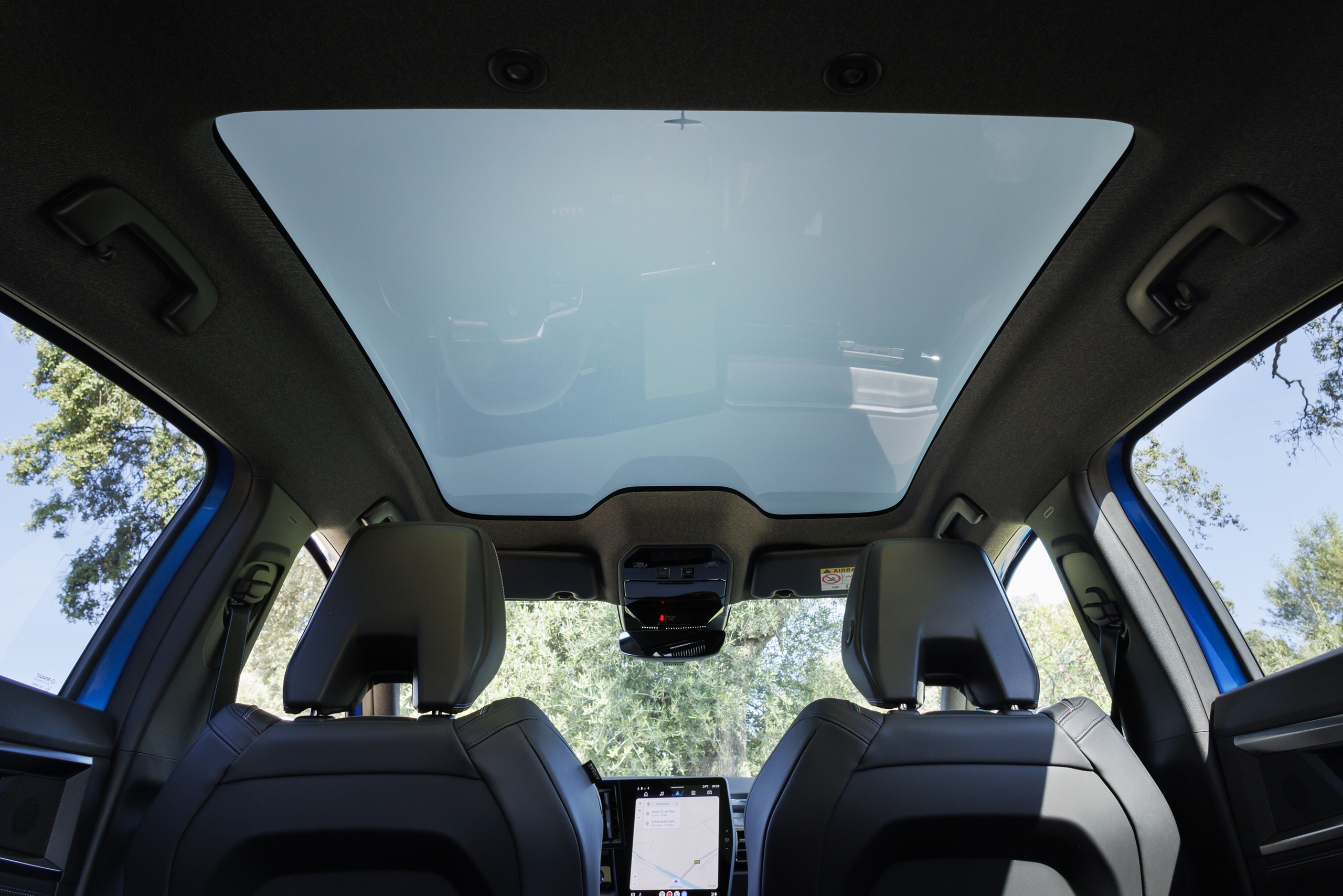
The real kicker of this test lies in the price. The Rafale E-Tech 300 4x4 is available... from around 53.300 eurosThe top-of-the-line Atelier Alpine version tested here starts at around €58.000. With delivery and a few options like special paint, the self-tinting Solarbay panoramic roof, or the Harman Kardon sound system, you quickly break the €60.000 mark. That sounds like a lot of money, and it is. But the crucial comparison makes the Rafale strong: A similarly equipped BMW X4 xDrive30e or Audi Q5 Sportback TFSI e quickly costs €75.000 or more. The French SUV thus undercuts its German competitors by around €15.000 and comes with features like all-wheel drive, matrix LED headlights, the large panoramic roof, and 21-inch wheels practically as standard. Furthermore, the plug-in hybrid versions currently qualify for an electric vehicle incentive of up to €4.500. (All prices in this article are as of June 2026 and include 19% VAT.)
Renault's warranty is solid, if not particularly impressive. Standard coverage includes a three-year manufacturer's warranty (two years plus a one-year extension via the Renault Plus Warranty) up to a maximum of 100.000 kilometers, plus an eight-year or 160.000-kilometer warranty on the drive battery with a guarantee of at least 70 percent remaining capacity, a three-year paint warranty, and a twelve-year anti-corrosion warranty. A mobility guarantee, which is automatically extended with a complete service history at a Renault dealership, rounds out the package. For added peace of mind, the warranty can be extended in terms of both duration and mileage within one year of initial registration. Compared to other manufacturers in its class, this is a decent offer; Hyundai and Kia, for example, offer more, with five to seven years of vehicle warranty coverage.
Image: Renault
Many thanks to Renault Germany for providing the Renault Rafale E-Tech 300 4x4 for this test report. This did not influence our opinion!