Our test conclusion
Football Manager 27
Football Manager 27 is a comeback after its buggy predecessor: more stable, more accessible, and with a tactics system that once again forces players to think carefully about their own team. Anyone disappointed by Football Manager 26, or who skipped it altogether, should definitely pick this up, especially with Game Pass. However, those who love Football Manager 2024 should prepare for a different experience.
- Tactics & Training 9
- Service 7
- Match Engine 7
- Presentation 8
- Stability 8
Pro
- Significantly more stable than Football Manager 26
- A tactical system with effectiveness and complexity ensures greater realism.
- More accessible interface with navigation bar
- Tactical adjustments directly in the game
- Cup draws and Deadline Day are back
Contrary to
- The surface still needs to be adjusted to.
- Defenders often react too late
- VAR reviews almost every goal
- Questions in press conferences tend to be repeated quickly.
- Minor bugs at release
I've rarely been as skeptical of a new Football Manager game as I was this year. I've been playing and testing the series for years, and the upheaval of the last two years has been a real test for fans. Football Manager 25 was completely scrapped, and its successor, Football Manager 26, arrived last fall with a new Unity engine, a revamped interface, and so many bugs that it felt more like a public beta. Many players simply stuck with Football Manager 2024 as a result. Consequently, my expectations for Football Manager 27 were quite high.
I've now played the new installment for a full season, which is about twelve to thirteen hours. Naturally, I played with my beloved HSV, on my MacBook Pro with an M1 Pro. To cut to the chase: Football Manager 27 has won me over. Sports Interactive has fixed many of the problems from last year, and the game is genuinely fun again. However, it's not Football Manager 2024, and that's something to keep in mind before you buy it.
SEGA provided me with the test key. The publisher had no influence on this test.
Interface and operation
The biggest problem with Football Manager 26 was its user interface. Back then, if you simply wanted to quickly check your squad or adjust a transfer offer, you often had to click through multiple levels and still wouldn't know exactly where the information you were looking for was hidden. Football Manager 27 addresses this issue directly. A navigation bar provides direct access to squad, tactics, scouting, and training; drop-down menus and shortcuts save clicks; and the start screen is once again much more customizable. Users can rearrange tiles or switch to text-only tabs.
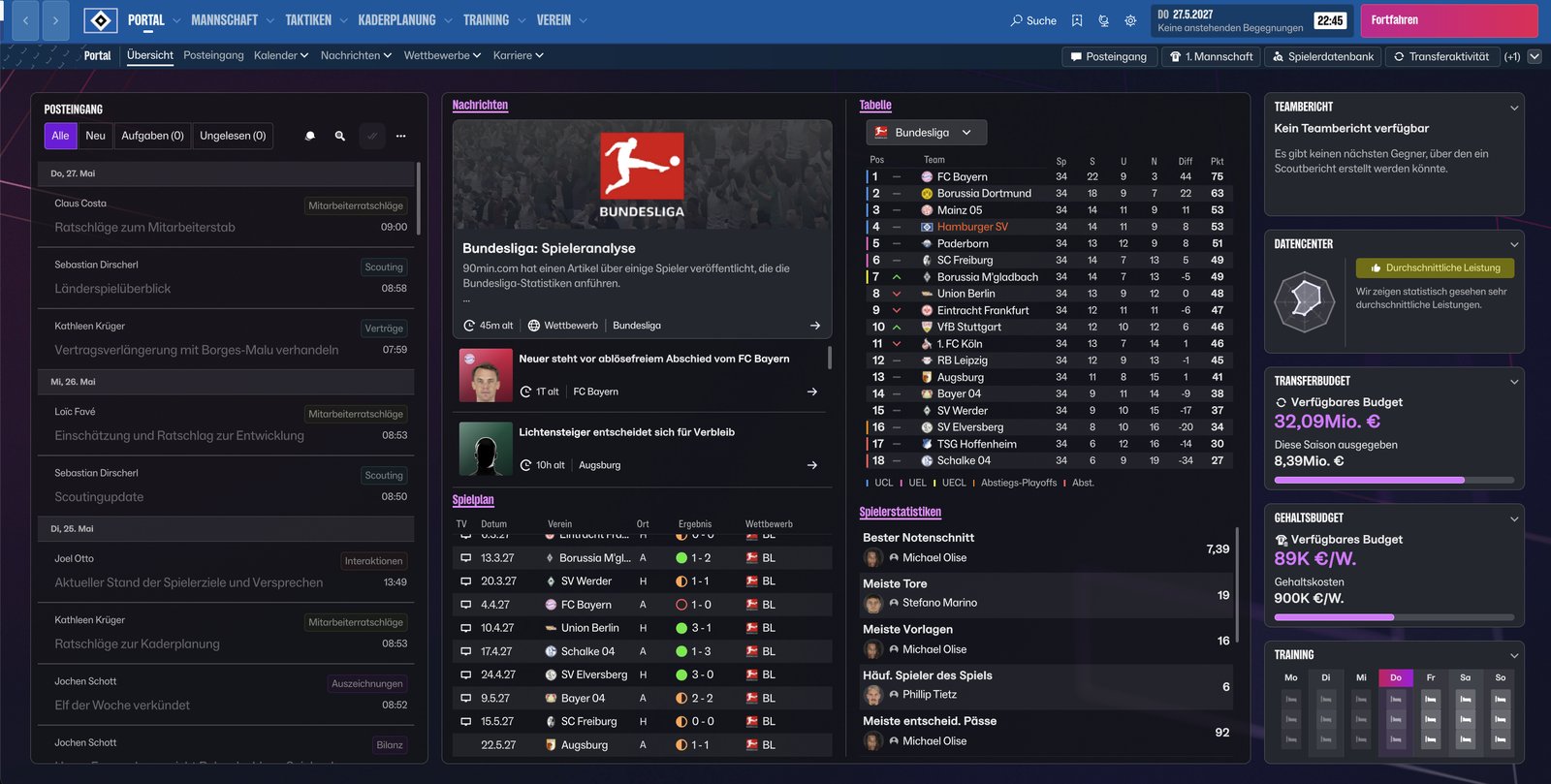
Also new is a setting that lets you determine how often the game pauses to display news and events when you click through. If you want to read every press release, you'll see everything; if you want to quickly get to the next matchday, you'll be interrupted much less often. I simply stuck with the default setting in the top corner and it worked well for me throughout the season.
The user interface isn't perfect yet. Especially in the first few hours, it takes some time to get used to it, and some information is still spread across different screens. However, this hardly bothered me in everyday use, even during transfers. Compared to last year, it's still a big step forward.
Tactics and training
The heart of Football Manager 27 is its tactics, and this is where Sports Interactive has made the most significant changes. A new feature is a tactical effectiveness indicator. This shows how well your team can actually implement the game plan, taking into account how familiar the players are with the tactics, whether their skills are suited to their roles, and how well they have been prepared for the upcoming opponent. There's also a tactical complexity indicator. Simply giving your team more and more instructions doesn't automatically improve them; in fact, it can easily overwhelm them.
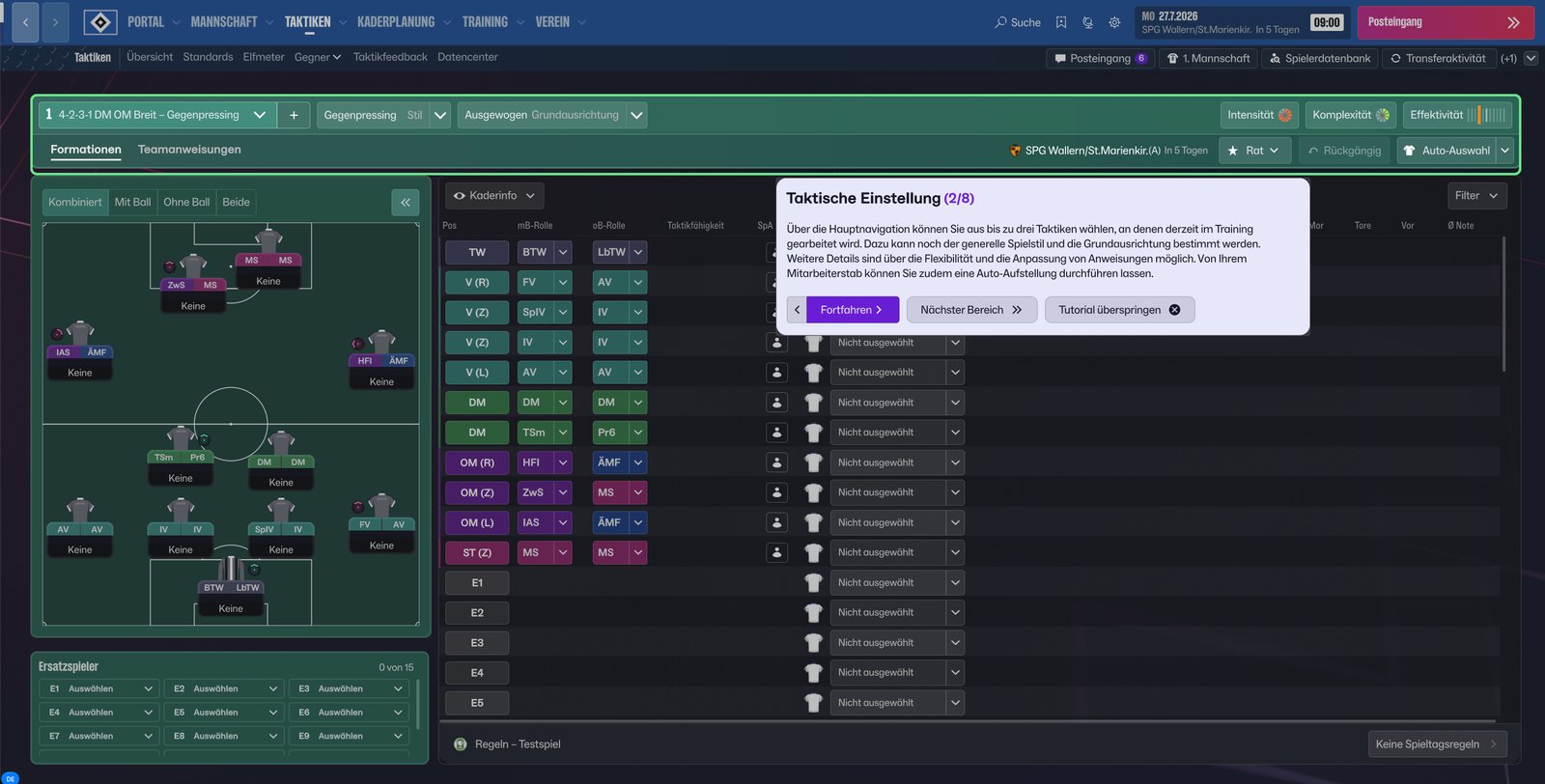
That sounds like a small detail, but it changes the approach. A tactic that works for a top club can't simply be transferred to a second-division team. You have to think more carefully about the players you actually have and what they're capable of, instead of copying a winning formula from the internet. Even counter-pressing, for years almost a shortcut to success, only works with the right players. At HSV, I relied on tiki-taka, in a 3-4-2-1 formation.
The individual attacking instructions have also been expanded. For example, you can specify whether a striker should delay his run into the penalty area or start directly behind the defensive line, and whether he should attack the near post, the far post, or the center.
Training is more closely linked to tactics. Sessions can be specifically tailored to pressing, build-up play, or defense; there are new drills, for example, against opposing press or for the offside trap; and training plans can be copied, so you don't have to start from scratch every week. The catch: It takes time for the team to internalize changes. In my case, it always took a few games before adjustments had an impact on the pitch.
Matchday and Match Engine
There's also more control on match day. So-called tactical tweaks allow for quick, minor adjustments during the game without having to open the full tactics screen. For example, you can increase intensity, adjust the pressing, have the wingers switch sides, or send the goalkeeper forward in the final stages. Instructions from the sidelines, on the other hand, primarily target the players' mental state: encouraging, calming, or rousing them.
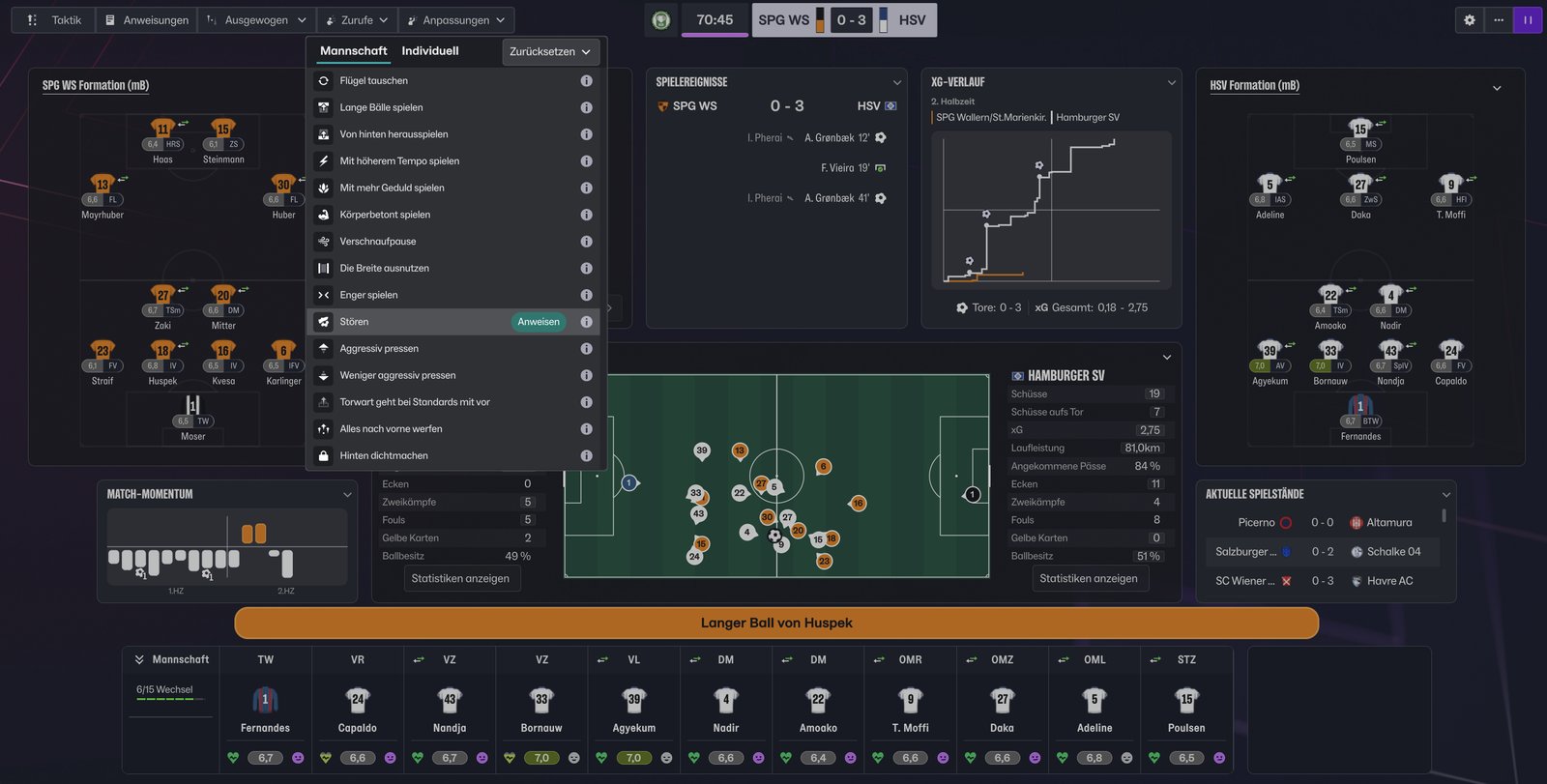
Visually, the 3D rendering has improved even further. Dribbling and running movements appear smoother, the spectators react more realistically, and the weather and lighting change as the game progresses. Of course, it can't compete with a real football match, but it doesn't need to. Those who prefer the classic 2D view will find smaller player markers and a clearer display. Heatmaps and pass networks also return after the match. I personally watch my games in 3D, and that's where the improvements are most noticeable.
The biggest weakness remains on the pitch, especially in defense. Defenders sometimes react too late, give the opponent too much space, and through balls unlock the defensive line more often than they should. I noticed this repeatedly during my season with HSV. It's frustrating because you invest a lot of time in tactics and then can't always determine whether a conceded goal was due to your own lineup or the engine.
There's also a detail that gets annoying after a while: almost every goal is immediately reviewed by VAR. While the inclusion of video review in the game fits with the desire for realism, its frequency is simply excessive and unnecessarily slows down the matches.
More life around the club
Some of the new features are actually returning. Cup draws are once again presented as a separate event, instead of just appearing as a dry league table, and Deadline Day is back – the final day of the transfer window with all its hectic activity. It's not a major feature, but these are precisely the kinds of moments that were missing, preventing a season from feeling like just a series of matchdays.
The transfer market offers a clearer overview of other clubs' activities, including confirmed transfers and rumors. The sporting director can suggest, upon request, the appropriate initial offer and how to split the payments, and scouting reports provide a clearer picture of whether a player fits the club's tactical approach. Furthermore, young talents are more focused on their development opportunities and may even accept a lower-paying offer.
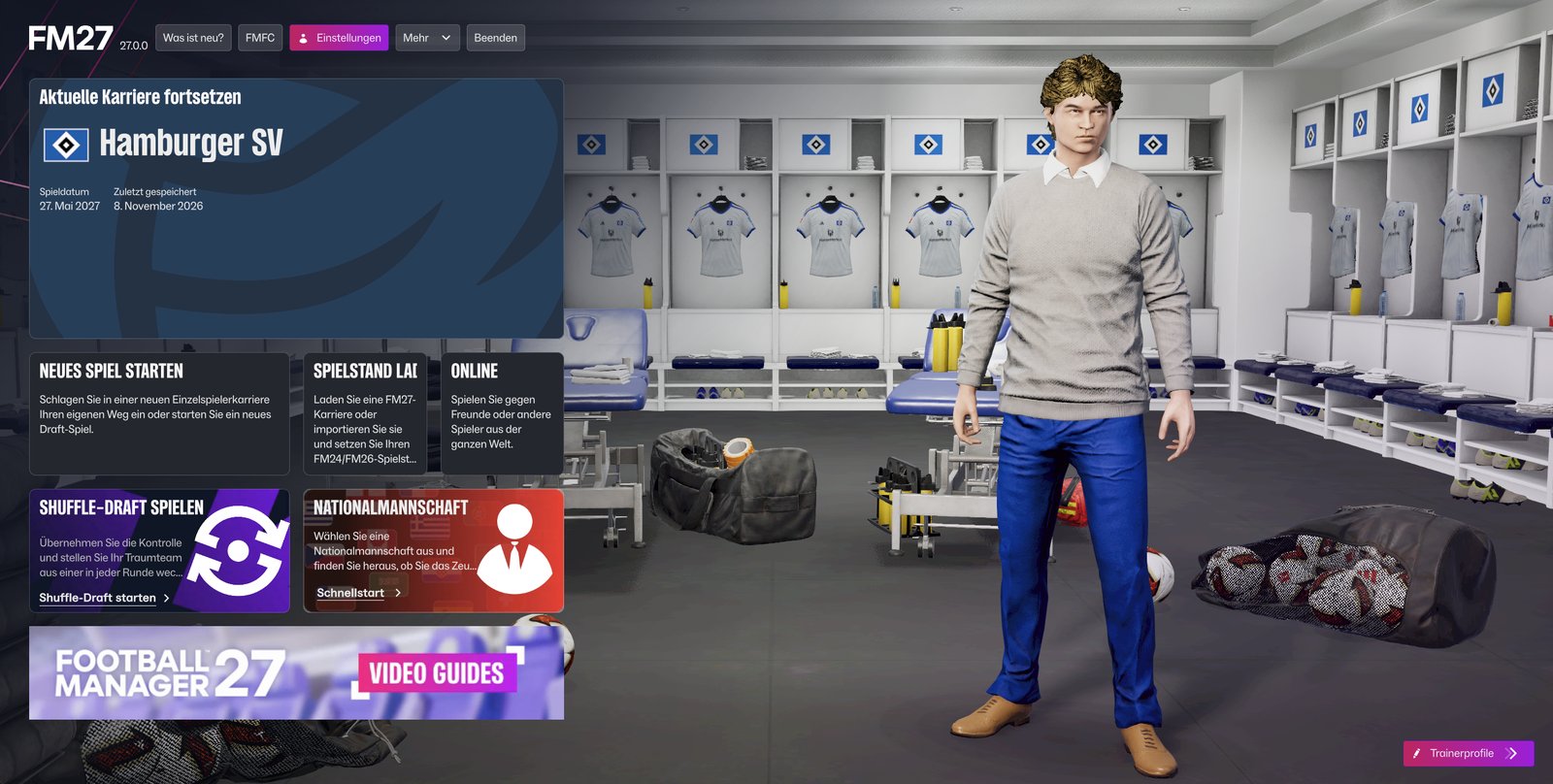
The appearance of the generated youth players has also been improved; last year, some of them looked rather odd. Creating your own manager now offers more options, including, for the first time, a wheelchair-bound coach who is also depicted as such on the sidelines and during cup celebrations.
Completely new is Shuffle Draft, a mode developed in conjunction with FIFAe. Multiple players simultaneously select players from rotating pools, assemble their teams, and then compete against each other in a tournament or league.proI don't have that mode; for me, the focus in Football Manager is on the long career.
Technology and stability
The most important point after last year: Football Manager 27 runs significantly smoother. On my MacBook Pro with an M1 Pro chip, the game ran stably throughout the entire season. It's not entirely bug-free, however. I did encounter some minor glitches, such as when players who were substituted on and off were mixed up. But these are minor issues that can be fixed with a patch and are nothing compared to the state of Football Manager 26 at launch. The system requirements have barely increased compared to Football Manager 26. According to Sports Interactive, a Mac with an M1 chip and at least macOS 13 is sufficient.
Not Football Manager 2024, but it doesn't have to be.
One point is important to me because it's currently being discussed a lot in the community: Football Manager 27 is not simply Football Manager 2024 with new graphics. The Unity engine, the new interface, and the revised tactics system remain; Sports Interactive has simply finally brought them to a point where they function properly. Anyone who considers Football Manager 2024 the pinnacle of the series will therefore have to adjust here as well. Furthermore, the game isn't quite complete yet; some features from older installments, such as a comprehensive season review, are still missing. And some things quickly become repetitive, such as the questions in press conferences, which you practically know by heart after a few weeks.
Football Manager 27 is significantly better than its predecessor in almost every aspect. What I enjoy most is the realism. You once again feel like you're managing a real club where squad, tactics, training, and transfers are interconnected, instead of just tweaking a few settings.
Price and availability
Football Manager 27 will be released on November 10, 2026, simultaneously for PC and Mac via Steam, the Epic Games Store, and the Microsoft Store, as well as for PlayStation 5 and Xbox Series X/S. The game will also be available as a mobile version on iOS and Android via Netflix. Football Manager 27 will be included in Game Pass from day one. The regular price is €59,99.
Conclusion
Football Manager 27 is the comeback many fans have been waiting for after Football Manager 26. The game runs more smoothly, the interface is significantly more user-friendly, and the new tactics system encourages players to think more about their own team instead of chasing a winning formula. Returning features like cup draws and Deadline Day further breathe new life into the season.
Football Manager 27 isn't entirely polished, however. The interface still takes some getting used to, the defenders on the pitch don't always make logical decisions, VAR intervenes far too often, press conferences become repetitive, and those who love Football Manager 2024 will find this a different game. But anyone who skipped Football Manager 26 or was disappointed by it should give the new installment a chance. For Game Pass subscribers, it's a no-brainer; for everyone else, Football Manager 27 is the first game in a long time that I can wholeheartedly recommend.