
Genesis is still a brand in Germany that you might briefly search for in the back of your mind before it clicks. And yet... luxury subsidiary of Hyundai It's no longer an experiment. And the Genesis GV70 Electrified is the best example of this, as it's intended to be a quiet rebellion against the German dominance. In this review, we explain how the revamped Korean model fares against its German competitors.
Spun off as an independent brand in 2015, the group brought in Luc Donckerwolke, Bentley's former chief designer, and the GV70 bears his signature from the very first iteration. The model launched in 2021 initially as a combustion engine vehicle, before the all-electric variant followed in 2022, which is simply called the Electrified GV70 internally and in the specifications. Unlike the smaller GV60, which is based on the pure electric E-GMP platform, the GV70 uses the company's adapted combustion engine architecture. That sounds like a combination of factors.promiss, and in one respect it is, but in everyday use the car plays to its strengths so convincingly that the platform question quickly becomes a footnote.
The Luxury version tested here represents the top-of-the-line trim and will arrive in a thoroughly revised form for the 2025 model year. My colleague was still driving it. the pre-facelift modelA car with a 77,4 kWh battery, numerous physical buttons, and a split-screen layout. That test declared the Korean car a hidden gem. Genesis now aims to defend precisely that status, because since the end of 2024, two German heavyweights, the Audi Q6 e-tron and the Porsche Macan Electric, have been on showroom floors, both built on a pure electric platform and boasting batteries exceeding 90 kilowatt-hours. The GV70 therefore needs to step up its game, and it does so on several fronts simultaneously. More battery, more screen, more finely honed sheet metal. This test drive will determine whether that's enough to maintain the gap.
Conclusion (tl;dr) on the Genesis GV70 Electrified:
The revised Genesis GV70 Electrified remains what it already was as a hidden gem, only better. The facelift With its larger battery and impressive 27-inch OLED display, the GV70 addresses precisely the areas where its predecessor lagged somewhat behind, without diluting the virtues that make it so appealing. It remains a car that prioritizes comfort, material quality, and quiet operation over the last tenth of a second of driving dynamics, thus embodying its own distinct and clear character. While the platform's limitations regarding interior space and battery size do exist, they are not as significant in everyday use as the specifications might suggest.
The Genesis can't compete with the Audi Q6 e-tron and Porsche Macan Electric in every aspect, especially not in terms of pure battery capacity or sporty handling. However, it counters with an excellent charging experience, a palatial interior, a distinctive appearance, and a service promise that makes the overall cost of ownership surprisingly attractive over the years. Anyone looking for a quiet, luxurious, and technologically sophisticated electric SUV, and willing to move away from the dominance of German brands, will find the GV70 Electrified offers more car than its price suggests. Genesis is brilliantly maintaining its status as a hidden gem, and it's high time it lost that status.
Strengths and weaknesses of the Genesis GV70 Electrified: The insider tip among electric vehicles
✅ Strengths
- Fast charging thanks to 800-volt technology with up to 240 kW and a constant charging curve.
- High-quality, quiet interior with a true premium character and excellent workmanship
- A distinctive, elegant design reminiscent of Bentley.
- Powerful engine with 490 hp and superior power delivery
- Excellent noise insulation thanks to Active Road Noise Cancelling and a powerful B&O system.
- Extensive standard equipment and a unique five-year service promise including maintenance
❌ Weaknesses
- Due to the platform, legroom in the rear is somewhat limited and the center tunnel is quite bulky.
- No active cornering lights despite a good matrix LED system
- Only 25 liters small frunk

Design and exterior of the Genesis GV70 Electrified: Luxury, interpreted Korean style
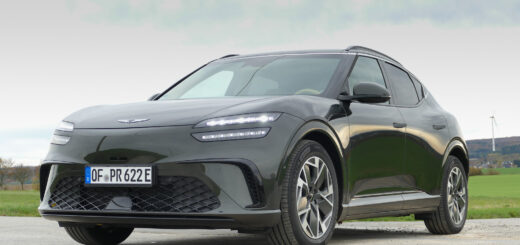
Visually, the GV70 remains what has made it special from the start: an SUV that defies easy categorization. The split headlights and taillights, a signature feature, stretch across the entire body, while the closed grille in the new dual-weave pattern gives the front depth without appearing bulky. Genesis deliberately kept the changes subtle with the facelift. The air intakes now feature a clamp-like contour, and the further developed headlights with micro-lens array technology are brighter and appear more precisely defined. Most noticeable is... the solution at the rearWhere the turn signals finally move from the bumper to the taillights, right where the eye expects them to be anyway. The third brake light now stretches broadly across the roof spoiler. These are subtle details, but they show that someone has been listening.
The test car arrives in Ceres Blue Matt, a shade of blue that almost appears purple and beautifully accentuates the powerful shoulders of the 4,72-meter-long body. The optional 20-inch wheels and white brake calipers add a sporty touch to the otherwise understated appearance. While a BMW iX3 exudes a decidedly sober and an Audi Q6 e-tron a coolly technical aesthetic, the Genesis feels warmer, almost regal. British luxury, interpreted Korean style. Those seeking a similarly distinctive design would typically find themselves spending well over €100.000. The GV70 offers this presence for significantly less, and that's precisely what makes it a conversation starter in the parking lot.


Space: Excellent in the front, but with a slight platform compromise in the rear.
Up front, the Genesis GV70 offers a truly regal experience. The ErgoMotion seats hug the body, providing massage, ventilation, and heating, and the 2,87-meter wheelbase promises generous legroom in the rear as well. The Genesis largely lives up to these expectations, but this is where the only real weakness of the platform choice becomes apparent. Because the GV70 isn't built on a flat electric skateboard Not because it's based on a conventional electric vehicle, but rather on a modified combustion engine architecture, the 84 kWh battery slightly raises the interior floor. As a result, tall adults in the rear sit at a slightly more angled position than they would in a purely electric vehicle. The bulky center tunnel, a legacy of its combustion engine roots, also reduces the space available for the middle rear passenger.
Compared to an Audi Q6 e-tron, which offers a flat floor and more legroom thanks to its PPE electric platform, the Genesis lags slightly behind in the rear. However, the space is still sufficient for two adults in the back. proNo problems, headroom and shoulder room are excellent, and heated seats are standard in the rear as well. Only when three larger people are traveling longer distances in the back does it become more cramped than in its German competitors. For the typical family with two children, the GV70 remains perfectly suitable for everyday use; the increased comfort in the front seats more than compensates for the slight disadvantage in the rear.


Trunk: 503 liters of practicality and a tiny frunk
Behind the tailgate, there's 503 liters of cargo space, a solid figure easily sufficient for two large rolling suitcases and a smaller trolley. Folding down the 60/40 split rear seats increases the volume to 1.678 liters. This allows for the transport of bulky items such as a disassembled bicycle or small pieces of furniture. Compared to the combustion engine GV70, which offers 542 liters, the electrification therefore only results in a negligible reduction in storage space, which is remarkable considering the battery is located under the floor.
Up front, under the hood, there's an additional frunk, but at 25 liters, it's rather symbolic. It's enough space for the charging cables, but not much more. This again highlights the platform's disadvantage, as pure electric vehicles like the BMW iX3 with its 510 liters of rear cargo space or the Audi Q6 e-tron with its larger frunk utilize the available space more efficiently. In everyday use, this rarely matters, as the 503 liters in the rear are well-designed, with a flat loading sill and low threshold. However, those who regularly transport heavy loads shouldn't consider the frunk a fully functional second storage compartment.


Interior of the Genesis GV70 Electrified: Where restraint meets luxury
The GV70's greatest strength lies in its interior, and that... Facelift raises the level Let's take another look. Genesis almost completely forgoes cheap-looking piano black trim. Instead, genuine Nappa leather, finely textured surfaces, and a pleasantly minimalist design dominate, yet it doesn't feel cold. The test vehicle combines Urban Brown with Frozen Gray, and the Nappa leather package enhances the seats and contact surfaces with quilted leather sections. Everything you touch feels expensive, from the satisfyingly clicky switches to the velour headliner. The biggest difference compared to my colleague's previous model lies in the cockpit: The previously split screen layout has given way to a continuous 27-inch OLED panel that merges the instrument cluster and infotainment system into a single panoramic display, offering around 30 percent more screen space.
Despite this digitalization, Genesis remains true to its clever operating philosophy. The climate control panel is still a physical unit, only moved slightly lower. The tried-and-tested rotary push-button controller in the center console is retained. This is invaluable in everyday use, as the central screen sits high on the dashboard, making it a bit too high for comfortable typing while driving. The rotary push-button controller, on the other hand, allows for intuitive and reliable operation. Added to this are comfort features that others forgo: the aroma diffuser of the fragrance package, the UV box for sterilizing keys and smartphones, and the ambient lighting with its Milky Way pattern. While some of these may not be strictly necessary, they underscore the car's claim to be a class above its price tag.


Infotainment & Connectivity: 27-inch OLED display and many buttons
The new OLED display is razor-sharp, offers deep blacks in contrast, and is perfectly readable even in direct sunlight. The menu structure is uncluttered and responds more smoothly, quickly, and intuitively than on many other devices. Hyundai and Kia models from the group. The operating logic, in its precision, is almost reminiscent of BMW, which is meant as a compliment. Apple CarPlay and Android Auto are wirelessly integrated, and charging route planning including battery preconditioning is included, as is a filter for preferred charging providers. Over-the-air updates keep the system up to date, a head-up display projects the most important information into the driver's field of vision, and the high-resolution digital rearview mirror from the options catalog provides a clear view to the rear even with a fully loaded trunk.
In detail, there's little to complain about. The augmented reality navigation overlays arrows directly onto the camera image and is particularly helpful at confusing intersections, even if the display occasionally lags slightly. Those who drive the electric GV70 get extras not available to its combustion engine counterpart, such as an off-road mode with its own menu system, including tilt and coordinate displays. Fingerprint recognition also allows the car to be started without a key and personal settings to be loaded directly. Furthermore, the Digital Key turns a smartphone into a vehicle key for up to three users. This is a well-thought-out feature and worked reliably in our tests. A satellite view of the map is still missing, but at least you can choose between the proprietary Neon map style and the classic corporate map display.


Sound system: Built-in silence and B&O sound
While its predecessor featured a Lexicon system, the facelifted GV70 Sport boasts a Bang & Olufsen audio system with 15 speakers and Dolby Atmos. The sound is clear, spacious, and underpinned by a powerful yet never overpowering bass. Voices are crisply positioned, and the highs remain crisp even at higher volumes. Dolby Atmos creates a soundstage that virtually elevates the audio experience, and with well-mixed recordings, it delivers a concert-like atmosphere rarely found in this price range. It doesn't quite reach the absolute top of, say, a... High-end Burmester in the Mercedes The system doesn't quite reach the same level, but for frequent listeners it is a clear recommendation to buy.
However, the real difference lies in the interplay with the Active Road Noise CancellingUsing microphones and active noise cancellation, the system dampens low-frequency road noise. This noticeably reduces the noise level in the cabin, especially on the motorway. The effect is subtle, but real: conversations are quieter, music needs to be played at a lower volume, and you get out of the car feeling more relaxed after long journeys. This acoustic tranquility is what defines the premium character of the GV70 more than any single technical specification. Anyone ordering the car should definitely opt for the B&O system, if only for the added quiet.


Assistance systems of the Genesis GV70 Electrified: Confidently helpful, never patronizing
The Genesis GV70 is not lacking in driver assistance systems. The second-generation Highway Driving Assist system maintains lane position, distance, and speed with ease, while the Lane Following Assist system operates smoothly and without any nervous oscillations. Additional features include an intelligent adaptive cruise control system that recognizes and adopts speed limits, an active blind spot monitor, a surround view monitor with a 360-degree camera, and an emergency braking system that also monitors cross traffic when reversing out of parking spaces. The automatic parking assistant maneuvers the car into a space at the touch of a button, and with Remote Smart Parking, the GV70 can even be pushed into tight parking spaces from outside using the key fob. In our test, all of these systems performed reliably and unobtrusively.
Compared to its predecessor, the range of driver assistance systems has remained virtually identical; it was already of a high standard back then. Where the Genesis stands out from some German competitors is the... calm voteThe systems don't patronize the driver, but only intervene when truly necessary. However, one point of criticism from the previous test remains: the otherwise excellent matrix LED system still lacks active cornering lights. In dark curves, the GV70 therefore illuminates straight ahead, while some competitors are already looking around the corner. A minor oversight in a car that otherwise does so much right.


Safety: Five stars and unwavering trust
On the passive safety side, the Genesis GV70 is comprehensively equipped. Eight airbags surround the occupants, and the body is reinforced. Five-star rating in the Euro NCAP crash test Designed for safety, the vehicle also features the aforementioned active systems, from emergency brake assist and lane keeping assist to parking collision avoidance assist, which warns of obstacles while maneuvering and brakes automatically if necessary. The combination of a robust structure and predictive electronics provides a high level of everyday safety without the driver consciously noticing it. That's exactly how it should be.
What's remarkable is how calm and controllable the two-ton SUV feels in critical situations. During a sudden evasive maneuver, the car remains stable and predictably on track thanks to the low center of gravity of the floor-mounted battery; the rear end follows cleanly without becoming nervous. The powerful brakes, visible behind the white calipers review vehicle, provide consistent and easily modulated deceleration. Overall, the GV70 conveys the feeling of sitting in a fundamentally sound, well-engineered car. For Genesis, safety isn't just a marketing ploy, but is tangibly built into the very fabric of the vehicle.


Comfort: The glider that swallows almost every wave.
Comfort is the discipline in which the Genesis GV70 excels. The predictive electronic suspension, the Preview Electronic Control Suspension, uses a camera to anticipate road imperfections and adjusts the dampers accordingly. In practice, the car smooths out transverse joints and bumps with remarkable composure, without any creaking or rattling in the interior. Add to that the ErgoMotion seats with massage function, which are ventilated and heated, the panoramic glass roof, and the aforementioned quietness. On long journeys, the GV70 displays a composure that weary travelers will gratefully appreciate.
Subjectively, the comfort level is slightly below what Volkswagen's adaptive DCC chassis It offers exceptional performance at the limit, particularly in terms of its sensitivity during rapid load changes. However, in normal driving conditions, where this car spends the vast majority of its time, there's hardly anything to criticize. The steering is precise without feeling overly direct, the noise insulation is excellent, and the seating comfort is first-rate. Anyone switching from a German premium SUV will immediately feel at home and, in some respects, even more pampered. The GV70 doesn't sell comfort as a feature; it embodies it.


The Genesis GV70 Electrified's powertrain: 490 hp of smooth, powerful thrust
Two electric motors operate beneath the metal sheet, one each. pro The axles together generate 360 kW (490 hp) and 700 Nm of torque. In boost mode, which unleashes full power for a few seconds, the SUV, weighing over two tons, sprints to 100 km/h in approximately 4,4 seconds. The speed is limited to 235 km/h.These figures are more of a demonstration than a necessity in everyday driving, because even in normal mode the GV70 accelerates with a force that makes any combustion-engine GV70 with its maximum 300 hp look outdated. The acceleration is instantaneous, without shift jolts, without delay – simply a rich, smooth surge of power.
Compared to its predecessor, the performance characteristics remain unchanged, and that's not a disadvantage. However, as with many electric vehicles, the performance drops when the charge level falls below approximately 30 to 40 percent. At that point, the GV70 drives a bit more sedately. For everyday driving, this is perfectly adequate, as it still cruises along. proIt handles traffic without any problems. The front electric motor can be decoupled in Eco mode to save energy on steady stretches. Those seeking more driving dynamics will find them in the significantly more expensive Porsche Macan Electric, but for a comfort-oriented luxury SUV, the Genesis's power delivery is almost ideally tuned.


Driving dynamics and handling: Not a cornering machine, but comfort-oriented.
In fast corners, the GV70 remains an SUV, and it doesn't try to hide that fact. Its tall build and weight of well over two tons mean that the car leans slightly over its outer wheels at higher speeds and gently bounces after weight transfers. This is easily controllable and never feels alarming, but those seeking true agility won't find it here. The GV70 isn't a corner-carver, but rather a cruiser that elegantly disguises its mass instead of trying to hide it. The steering provides ample feedback without being twitchy, and the all-wheel drive system puts the power down cleanly at all times.
Anyone familiar with the Porsche Macan Electric knows what's possible in this segment in terms of driving dynamics, but this comparison is also unfair, as the Porsche costs considerably more and follows a different philosophy. The Genesis doesn't aim to be the fastest through the corners, but rather the most composed on long journeys. And that's precisely what it achieves. On the motorway, the GV70 feels planted and stable, lane changes are smooth, and the suspension reliably absorbs even rough road surfaces. For a car whose buyers Comfort and representation If you're concerned about the last tenth of a second on the open road, this vote is absolutely spot on.


Battery: Upgrade to 84 kWh
The centerpiece of the facelift is the new battery. Instead of the previous 77,4 kWh, 84 kWh of gross capacity is now available, an increase of around eight percent. The engineers utilized every millimeter of space in the underbody of the mixed architecture to accommodate the larger battery pack. It is the same battery that is also used in the revised Hyundai ioniq 5 and is used in the Kia EV6, a proven and mature package. Its key strength remains the 800-volt architecture, which, together with second-generation battery preconditioning, ensures consistently high charging performance, even in cooler temperatures.
However, a comparison with the competition reveals the downside. Audi Q6 e-tron and Porsche Macan Electric proElectric vehicles with batteries around 100 kWh outperform the Genesis on paper. At first glance, the GV70's 84 kWh battery seems short-sighted. But this impression is deceptive, as its true strength lies not in capacity, but in the efficiency of the overall system and, above all, in charging speed. Where its German competitors with larger batteries charge less frequently but for longer periods, the Genesis compensates with shorter, more frequent charging stops. A heat pump is standard equipment and noticeably reduces the heating system's energy consumption in winter.

Consumption & range of the Genesis GV70 Electrified: Comfort comes at a price
Genesis states a WLTP consumption of 19,4 kWh per 100 kilometers, a respectable figure for an SUV weighing over two tons and boasting 490 hp. In practice, the actual consumption depends heavily on driving style.profil ab. During mixed driving with city, country roads and moderate motorway, the GV70 settles down. in our test at around 20 to 21 kWh A range already achieved by its predecessor. Those who primarily drive in the city and on country roads and make smart use of recuperation can easily reduce consumption below 19 kWh. The smart braking function with the i-Pedal allows for one-pedal driving, which recovers energy in city traffic and makes the driving experience pleasantly relaxed.
The situation is different on the motorway. The SUV shape takes its aerodynamic toll at 130 km/h, causing consumption to rise significantly, and figures exceeding 24 kWh are not uncommon. This reveals that the GV70 is not an electric car optimized for maximum efficiency, but rather a comfortable cruiser that prioritizes effortless performance. While there are more economical options in this class, the Genesis remains within the typical range for its high-performance competitors. The relatively fast charging speed considerably mitigates the slightly higher motorway consumption in everyday driving, as a quick stop recharges the battery rapidly.

Range: Realistic 380 to 420 kilometers
On paper, Genesis quotes a WLTP range of up to 479 kilometers, a moderate increase compared to the 455 kilometers of its predecessor. The increase is smaller than the eight percent larger battery capacity would suggest, because the higher weight and the slightly increased demands on comfort features eat up some of the gain. With the optional 20-inch wheels on the test vehicle, the real-world figure is also somewhat below the best result achievable with smaller 19-inch wheels. In everyday use, this means... realistic 380 to 420 kilometers For mixed driving conditions, this is a practical value that will satisfy most commuters. progets me through the week without any problems.
On long journeys at higher motorway speeds, the range naturally decreases more significantly, making 300 to 350 kilometers between charging stops more realistic. This might initially sound like a weakness compared to its German rivals with their larger batteries, but in practice, this disadvantage is less pronounced. Thanks to the short charging times, frequent charging is hardly time-consuming. Those who drive the GV70 over long distances quickly become accustomed to the rhythm of short trips followed by lightning-fast charging, which, overall, is hardly slower than that of its competitor with the larger battery and slower charging curve.

Charging: 800 volts and V2L
This is where the GV70 plays its biggest trump card. The 800-volt technology allows for charging at a suitable fast-charging station. Peak output of up to 240 kWAnd what's truly impressive isn't just the maximum charging speed, but the consistency of the charging curve. Genesis claims a mere 19 minutes for a charge from 10 to 80 percent, a figure that makes the GV70 one of the fastest chargers in its segment. Anyone who's ever been stuck at a competitor's car charging at a snail's pace knows what this difference means in everyday travel. A quick coffee break is all it takes, and the battery is fully charged for the next long leg of the journey. The heated charging port can be opened electrically, further enhancing the overall comfort.
The GV70 charges at up to 11 kW using AC power. A full charge at a home wallbox takes just under eight hours, which is perfectly sufficient for overnight charging. This is particularly convenient. V2L package (Vehicle 2 Load) The car's charging capability allows for the operation of external devices with up to 3,7 kW, from electric grills to e-bikes. The car thus becomes a mobile power outlet. In direct comparison with the Audi Q6 e-tron and Porsche Macan Electric, which also utilize 800-volt technology, the Genesis performs on par. However, compared to competitors with a purely 400-volt architecture, it clearly outperforms them in charging. This charging performance is and remains the GV70's strongest technical selling point.


Price & Warranty of the Genesis GV70 Electrified: Seems expensive, but can keep up.
The Electrified GV70 Sport starts at 74.900 euros For the base model. Our test vehicle, equipped with numerous extras, comes to a price of around €85.220. The optional extras include the Capri Blue Pearl paint finish for €950, the Nappa leather package for around €2.930, the Bang & Olufsen sound system for €1.570, the 20-inch alloy wheels for €1.000, and numerous comfort features such as the digital rearview mirror, the V2L package, and the interior fragrance package. It's not exactly a bargain, but considering the generous standard equipment, which often costs extra with German competitors, the pricing is fair. Anyone familiar with the options list of a comparable Audi Q6 e-tron or Porsche Macan Electric will quickly realize how much car the Genesis offers for the money.
The real difference, however, lies in the Genesis service promise. The Care Plan LITE bundles all scheduled service and maintenance work according to manufacturer specifications for five years, including labor, spare parts required for regular maintenance, and a loaner vehicle for two calendar days at a time. pro Service. Recently, this package has been removed from the standard equipment in Germany and is now an optional extra costing €2.270 (still available at no extra charge in Switzerland). This slightly diminishes the once all-inclusive benefit, but it remains an attractive offer, as this level of predictable costs over five years is rare in the premium segment. Those who order it know their maintenance costs up to 75.000 kilometers in advance and also benefit from the pick-up and delivery service, including a replacement vehicle.
While German competitors also charge separately for maintenance and service, Genesis offers a transparent, all-inclusive package. When factored in over the ownership period, the perceived price disadvantage compared to established brands shrinks considerably, and the Korean model becomes a surprisingly rational choice. (All prices in this article are as of June 2026 and include 19% VAT.)

Many thanks to Genesis Germany for providing the Genesis GV70 Electrified for this review. This did not influence our opinion!