
The future of printers - where is it headed?
of Stella Hirschlich 
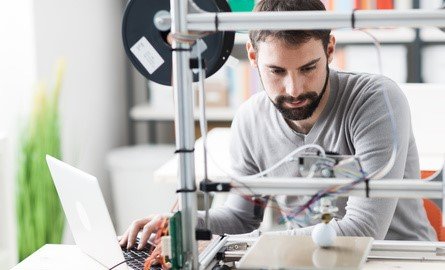
The technology of 3D printing is not yet fully developed, so researchers are already working on a 4D printer. With this, different materials are to be assembled like with a 3D printer, but the resulting object should now be able to change due to various influences. Such a development was unimaginable just a few years ago. Overall have pressureprohas a long history behind it. And an end is far from in sight.
From the invention of letterpress printing to home printing
Johannes Gutenberg was the first to revolutionize printing. In the middle of the 19th century, he developed his movable type, which made it possible to print large numbers of fonts for the first time. However, printing was still very expensive, mainly because of the high cost of paper. That changed in the course of industrialization, when paper became cheaper and, for example, newspapers could be printed for the masses. Offset printing was invented in 1907 and is still used today. In the 20th century there were more and more inventions that made printingprocess always further simplified and qualitatively improved. Today there is a printer in every household. Cartridges, toner cartridges and printer accessories can now be conveniently ordered in the online shop.
The revolution in printing - the 3D printer
The first 3D printer was developed in the 1980s, but only now is this groundbreaking invention slowly finding its way into our everyday lives. With such a printer, a wide variety of things can be printed, such as prostheses or gears. Many see a future in which everyone can print everything from glasses to a new couch. Even foodstuffs such as fruit gums can now be printed. A functioning firearm has also already been printed. However, 3D printers are not yet affordable for most households.
The research continues
The 3D printer has not yet fully established itself in our everyday lives, as experts are already researching a printer that adds another dimension to printing: time. Because in the future, 3D printers will create objects that can move and adapt to their environment. These printers are consequently referred to as 4D printers. One possible area of application could be dentistry. But it should also be possible to print pipes that automatically generate waves and thus independently transport water, or furniture that the customer assembles himself. The imagination knows no limits.
Constant improvement in 2D printing
But it's not just futuristic printers that are being researched constantly; 2D printing has also been constantly improved in recent years. The trend here, for example, is moving away from new toners and towards so-called rebuilt or refill variants. While refill toner is a product that has already been used and is filled with new ink, with rebuilt toner the dealer also replaces wearing parts from a cartridge that has already been used. This ensures flawless use with high quality.

Nice article, more of it!
Edited by TechnikNews on 22.04.16/20/42, XNUMX:XNUMX pm (link removed)