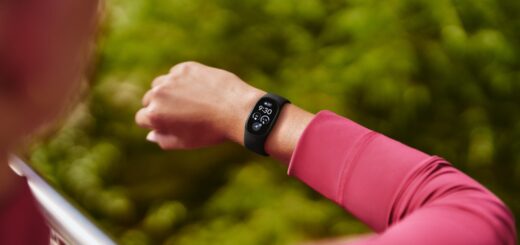

Google is taking an unusual approach in the wearable market with the new Fitbit Air.. Inspired by the "Whoop" approach, their new fitness tracker completely forgoes a display.. Instead, the device relies on a simple design and shifts all visual interaction to the smartphone.. The goal: Seamless health tracking in everyday life, without constantly distracting the user with notifications or live views of their wrist.. Our review will reveal whether the concept works and how the new AI coach, developed with Gemini, performs..
Design and hardware: Feather-light and inconspicuous
Upon unpacking, the minimalist casing immediately catches the eye; it is made from recycled polycarbonate and PBT plastics.. Weighing just 5,2 grams (without the wristband), the wearable is virtually imperceptible on the wrist in everyday life.. The flexible design also allows for quick switching between sport and premium wristbands..

Thanks to its water resistance of up to 50 meters (5 ATM), the Fitbit Air does not need to be removed when showering or swimming.. In addition to the classic color variations Obsidian, Fog, Berry and Lavender, a special "Stephen Curry" edition of the bracelet is also available at launch, but unfortunately only in the USA..

Technical specifications at a glance
Dimensions: 34,9 x 17 x 8,3 mm
Weight 5,2 g (without strap) / 12 g (with strap)
Battery life: Up to 7 days
Charging time: Approximately 90 minutes for 100%; Fast charging provides 1 day of use after 5 minutes.
Sensors: Optical heart rate monitor, SpO2 sensors (oxygen saturation), skin temperature sensor, 3-axis accelerometer, gyroscope
connectivity: Bluetooth 5.0 LE
Compatibility: Android 11.0 or higher and iOS 16.4 or higher
Workout tracking: Uninspiring interface and less data than Whoop
However, in everyday athletic practice, the concept also reveals its first weaknesses. Since there is no display available for a live view during training, the smartphone has to be pulled out every time the current performance data is checked.Furthermore, the display within the Google Health app unfortunately appears rather uninspired when tracking workouts.. A dynamic and visually appealing presentation of the training zones is lacking, which makes the interface seem somewhat outdated compared to dedicated sports apps.

Furthermore, the Fitbit Air collects significantly less in-depth fitness and stress data overall than its direct competitor from Whoop.Therefore, anyone looking for absolutely seamless performance tracking with in-depth physiological analyses of training load (strain) and regeneration should still opt for the Whoop despite the higher price..
Battery life and subscription model: A critical look at the costs
In terms of endurance, the display-less concept is convincing across the board: In test operation, the tracker achieved proEasily achieves a battery life of up to 7 days. Should the power run low, the fast charging function ensures that after just 5 minutes on the charger there is enough energy again for a full day of use.. A full charge takes approximately 90 minutes..
However, one important aspect that buyers should consider before purchasing is the ongoing cost: The full functionality of the tracker, as well as the advertised AI features of the Google Health Coach, absolutely require an active "Google Health Premium" subscription.. The purchase includes three months of the service free of charge.. After this trial period, a monthly fee of €8,99 will be charged.. Those who cancel their subscription can still use the tracker – unlike its competitor Whoop – but will have to live with a significantly limited range of functions..
Conclusion: Prices and availability
The Google Fitbit Air is now available in stores for a purchase price of €99,99.. Additional accessory wristbands are offered by Google starting at €44,99..
In summary, Google delivers a successful, highly focused wearable with the Fitbit Air. For users seeking continuous and unobtrusive monitoring of their health metrics without constant screen distractions, the device is an excellent and affordable alternative to established high-end screenless trackers. Only the ongoing cost of the premium subscription mars the otherwise very positive overall impression.